If you are considering psychedelic-assisted treatment in Switzerland (for yourself or for someone close to you) four legal routes exist in July 2026, and one of them is found nowhere else in Europe: a limited medical use program under which individually authorized physicians treat patients with psilocybin, LSD or MDMA when standard treatments have failed. The other three are reimbursed esketamine at officially designated centers, private off-label ketamine, and clinical trials. Every route is gated by your documented treatment history, so the most useful preparation is a written list of every treatment you have tried, with dose, duration and outcome; you can begin orienting yourself with our eligibility check.
TL;DR Spravato is reimbursed by basic insurance (OKP) for severe treatment-resistant depression, but only at the 52 BAG-designated centers, only after your insurer's trust doctor approves a cost request, and for a maximum of 10 months (extendable twice by 3 months). The Limitatio requires at least 2 failed antidepressants plus a failed augmentation attempt and CGI-S severity of 5 or more. Separately, authorized psychiatrists may treat named patients with psilocybin, LSD or MDMA under the limited medical use program, around 100 physicians and 723 patients in 2024, usually self-paid, with waitlists of many months. Private ketamine runs CHF 300–500 per infusion, and Basel and Zurich anchor one of Europe's densest trial scenes.
At a glance
| Route | Substance | Status in Switzerland | Who qualifies | Cost |
|---|---|---|---|---|
| Reimbursed esketamine | Esketamine (Spravato) | On the Spezialitätenliste since 1 October 2025 (temporary limitations to 30 September 2028); running at 52 designated centers | Age 18–74, severe treatment-resistant depression, 2 failed antidepressants plus 1 failed augmentation, CGI-S 5+, ECT not indicated, refused or not accessible | Covered by OKP after trust-doctor pre-approval; 10-month cap |
| Limited medical use | Psilocybin, LSD, MDMA | Legal under Article 8 Narcotics Act exceptional-use permits; about 100 authorized physicians | Serious condition with standard treatments exhausted, accepted by an authorized psychiatrist for a named-patient permit | Usually self-paid |
| Private ketamine | Ketamine (off-label) | Legal | Off-label decision after medical screening | ~CHF 300–500 per infusion, self-pay |
| Clinical trials | LSD, MDMA, psilocybin, DMT, ketamine, others | 73 trials tracked, 15 active; several recruiting | Study-specific criteria | Free |
Full coverage details: Is Spravato reimbursed in Switzerland?
Esketamine (Spravato): reimbursed, but only at designated centers
Spravato entered the Spezialitätenliste on 1 October 2025 with temporary limitations running to 30 September 2028, under a strict Limitatio. Per the BAG listing documentation and the standard insurer request form, reimbursement requires:
- Age 18–74 with a severe treatment-resistant episode of major depression;
- Failure of at least 2 different antidepressants plus 1 augmentation attempt (lithium or an atypical antipsychotic) at adequate dose and duration;
- Severity of CGI-S 5 or higher;
- Electroconvulsive therapy currently not indicated, refused, or not accessible;
- Use in combination with an oral antidepressant.
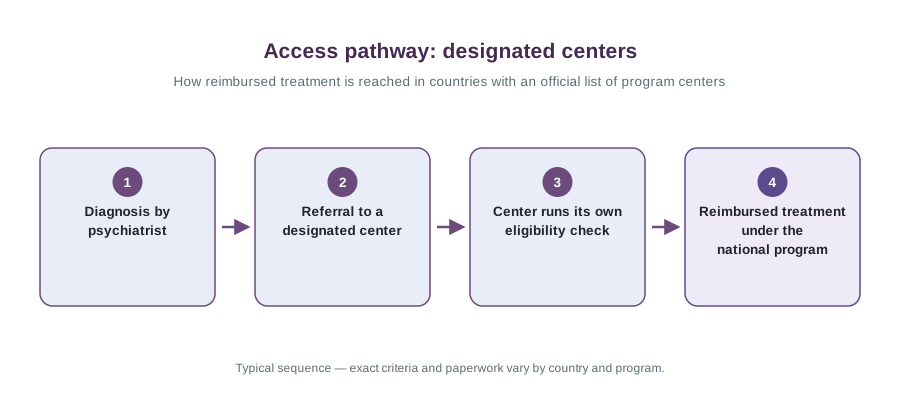
Where and how: Prescribing is restricted to psychiatrists at the 52 centers designated by the BAG, institutions with a cantonal mandate for adult psychiatric care. Before the first dose, the center submits a cost approval request (Kostengutsprache) to your insurer, reviewed by the trust doctor (Vertrauensarzt). Practically: ask your psychiatrist for a referral to the nearest listed center, bring a complete medication history, and budget some weeks for the pre-approval step.
The time limit: Coverage runs for a maximum of 10 months, extendable at most twice by 3 months each when continued response is documented. Discuss the maintenance and exit strategy at the start, not at month nine. For how Switzerland's arrangements compare with the rest of the continent, see our Europe-wide reimbursement map.
Psilocybin, LSD and MDMA: the limited medical use program
This is the Swiss specialty. Under Article 8 of the Narcotics Act, the Federal Office of Public Health (FOPH/BAG) can grant exceptional case-by-case authorizations for the medical use of otherwise prohibited substances. A physician applies for a named patient, justifying that the condition is serious, standard treatments have been exhausted, and the substance may relieve suffering. MDMA and LSD have been available this way since 2014, psilocybin since 2021 (program history, peer-reviewed).
Uptake is considerable but controlled. In 2024, about 100 physicians held authorizations covering 723 patients (MDMA mostly for PTSD, psilocybin mostly for depression and end-of-life distress) typically 2–4 dosing sessions per patient within 12 months, embedded in ongoing psychotherapy. A 2025 BAG-commissioned expert report confirms the same picture: roughly 700 permits granted in 2024 across around 100 treating physicians, with psilocybin the most requested substance and permit numbers rising every year since 2021. How a patient realistically gets in:
- Access runs through the physician, not the BAG. You cannot apply yourself; you need an authorized (or willing-to-apply) psychiatrist to take you on, and the permit is issued for you by name, with your consent. There is no public directory of permit holders, so the realistic path is a referral from your treating psychiatrist to a practice experienced with the program. Waitlists at such practices commonly run many months.
- Costs are usually private. These treatments are not on the Spezialitätenliste and basic insurance does not routinely pay. Budget for preparation sessions, supervised dosing days of 6+ hours, and integration sessions.
- It is designed for patients in Swiss care. Authorizations are physician- and patient-specific, applications involve Swiss residency requirements, and providers require the ability to attend multiple in-person visits: cross-border "therapy tourism" is not what the program is for.
- It is not a single-session cure. Expect a treatment arc over months inside an ongoing psychotherapy, not a standalone appointment. Note also that this FOPH permit route is the only pathway: the 2025 expert report states Switzerland had no separate Swissmedic compassionate-use program for psychedelics in operation.
Ketamine: private off-label infusions
Licensed physicians may also offer off-label ketamine privately, typically around CHF 300–500 per infusion. Reimbursement is the exception, not the rule: FOPH commentary from 2023 records that a request to add ketamine to the reimbursement annex for depression and pain was rejected, so psychiatric ketamine remains essentially self-pay (Blossom's Switzerland access guide). Verify cantonal practice authorization via MedReg and apply the usual clinic-choice checks: psychiatric and cardiovascular screening before payment, a physician present during sessions, and measured outcomes.
Clinical trials in Switzerland
The research route is denser here than almost anywhere in Europe: Blossom tracks 73 psychedelic trials connected to Switzerland, 15 of them active (Blossom's Switzerland report). Basel, above all University Hospital Basel, anchors clinical pharmacology and patient studies, while Zurich focuses on neuroimaging and translational psychiatry; Geneva and Bern also run programs. Currently recruiting studies include Phase 1 work on intravenous 5-MeO-DMT and on MDMA for experimentally induced pain, plus a pharmacokinetic comparison of an LSD derivative with LSD; many Swiss trials enrol healthy volunteers, with patient studies in depression, alcohol use disorder and palliative distress. Participation is free and legal, but screening is strict and enrolment is never guaranteed. See the trials guide for how phases, placebo and consent work, and search ClinicalTrials.gov for current listings.
What to expect in treatment
Medically reviewed by Dr. Amy Reichelt, PhD, 31 July 2026: this section and the risks section below.
These routes share a shape (medical screening, supervised administration, structured follow-up), but they are not interchangeable: the indication, the schedule, the staffing and the strength of the evidence all differ depending on whether you are prescribed Spravato (esketamine), given ketamine, or entering a legal psychedelic-assisted therapy route, where your country has one. What every route has in common is where it starts. Treatment begins with a screening appointment: the clinician reviews your psychiatric and medication history, checks your cardiovascular health and current medicines, and confirms the diagnosis before anything is scheduled. This is also where contraindications are caught.
On a Spravato day you self-administer the nasal spray in the practice or clinic under supervision, then stay for an observation period of roughly two hours while staff monitor blood pressure, heart rate, sedation, dissociation, breathing and overall recovery. Dissociation, dizziness, sedation, nausea and a temporary rise in blood pressure are common (though they do not occur in everyone), and settle as the drug clears. You must not drive, operate machinery or undertake anything hazardous until the following day, after a night's sleep, so arrange transport home. Induction is typically more frequent at first and then tapers based on measured response. Under the European label, Spravato for treatment-resistant depression is taken alongside a continuing oral SSRI or SNRI antidepressant.
A ketamine infusion for depression is an off-label use of the drug. It is usually given intravenously over about 40 minutes, with vital-sign and psychological monitoring and a recovery period afterwards. Some services offer ketamine-assisted psychotherapy (KAP), which wraps the dosing in preparation and integration sessions with a therapist; others provide ketamine as a medical antidepressant treatment with no psychotherapy component at all, which is worth establishing before you book. Where a legal psychedelic-assisted therapy route exists, and what that route is depends on the country: a clinical trial in most, a regulated programme or compassionate-use scheme in a few; dosing days are long and closely supervised by trained clinical staff, and sit inside a broader plan of preparation, general psychiatric care and integration. In every setting the medicine is one part of the plan: screening, monitoring and follow-up reduce risk but cannot eliminate it, and psychotherapy or integration may help you make sense of what the treatment brings up and apply it afterwards.
Risks and who should not start
These treatments are generally well tolerated under supervision, but they are not for everyone, which is exactly what screening is for. Common, transient effects during or shortly after a session include dissociation (a detached, dreamlike feeling), nausea, mild perceptual changes, and a short-lived rise in blood pressure and heart rate; these resolve as the drug is metabolised. Treatment may be inappropriate, or require particular caution and specialist evaluation, when any of the following apply:
- Uncontrolled hypertension or significant cardiovascular instability, including a history of aneurysmal vascular disease. This is a contraindication for Spravato, because of the temporary rise in blood pressure; the other treatments carry their own cardiovascular assessment.
- A personal or family history of psychosis or bipolar disorder: a particular caution for classic psychedelics such as psilocybin, which legal programmes screen for carefully.
- Pregnancy or breastfeeding.
- Current uncontrolled substance use, a history of ketamine misuse, or a high risk of compulsive use: any of these may make treatment inappropriate or require specialist assessment.
A responsible provider screens for all of these before the first dose. Careful screening, monitoring and follow-up reduce risk; they do not remove it. If a clinic is willing to treat you without that assessment, treat it as a warning sign; see our clinic-choice guide. To see who is listed near you, browse providers in Switzerland.
Reviewer's note. Ketamine, Spravato (esketamine) and psilocybin-assisted therapies share common elements such as screening, supervision and follow-up, but they should not be presented as interchangeable. Each has distinct indications, contraindications, monitoring requirements and levels of evidence. Spravato follows a regulated treatment pathway, while IV ketamine is generally used off-label and psilocybin therapies remain largely investigational. Importantly, careful screening and clinical monitoring reduce risk but do not eliminate it.
— Dr. Amy Reichelt, PhD, neuroscientist, chartered psychologist and psychotherapist, PsyAccess medical reviewers
Frequently asked questions
Do I have to try ECT before Spravato is covered?
No: the Limitatio requires that ECT is currently not indicated, is refused by you, or is not accessible. Your psychiatrist documents which applies.
What happens when the 10-month cap is reached?
Coverage ends after at most two 3-month extensions. Continuation would be self-paid, so agree a maintenance and exit plan with your psychiatrist from the outset.
How do I find a physician authorized for psilocybin, LSD or MDMA therapy?
Through a referral from your treating psychiatrist to a practice experienced with the limited medical use program: there is no public list of permit-holding physicians, and you cannot apply to the BAG yourself. Expect a waitlist of many months, and be wary of anyone advertising fast access. You can also browse providers in Switzerland to see who is listed.
Can foreigners come to Switzerland for MDMA or psilocybin therapy?
Rarely: the program is designed for patients within Swiss care: authorizations are physician- and patient-specific, applications involve residency requirements, and most providers require local follow-up. Be cautious of anyone advertising easy access.
Are psilocybin retreats in Switzerland legal?
No. Outside limited medical use authorizations and clinical trials, psilocybin remains prohibited. Retreat-style offerings without a BAG authorization are illegal, whatever their marketing says.
How long is a session, and can I drive afterwards?
Most of a morning or afternoon for Spravato, and in every case you should not drive until the next day. Budget for a short administration plus a roughly two-hour observation; a ketamine infusion runs about 40–60 minutes plus recovery, and program dosing days with psilocybin, LSD or MDMA commonly last 6+ hours. Plan a lift home.
Coming from another country? Whether a clinic will take a non-resident self-pay patient, what a Spravato induction schedule means for a visitor, and where cross-border treatment actually works: ketamine & psychedelic therapy in Europe for international patients.
Sources
- BAG: SPRAVATO Neuaufnahme Spezialitätenliste (PDF)
- BAG: Liste der Zentren gemäss der Limitierung von Spravato (PDF)
- Vertrauensärzte: Spravato Kostengutsprachegesuch (PDF)
- FOPH/BAG: Beschränkte medizinische Anwendung von verbotenen Betäubungsmitteln
- BAG expert report 2025: Ärztliche Anwendung von Halluzinogenen und MDMA (PDF)
- Implementing psychedelic-assisted therapy: the Swiss limited medical use program (PMC)
- Blossom: Switzerland country report
- Blossom: Medical access in Switzerland
- Psychedelic Alpha: Swiss exceptional authorisations in context (2024 figures)
- MLL: Legal framework for the use of psychedelics in Switzerland
- MedReg: Swiss medical professions register
This guide is for general information only and is not medical advice, a diagnosis, or a recommendation of any treatment. Regulations and reimbursement rules change; always verify current requirements with the BAG, your insurer, and a licensed clinician who knows your history. If you are in crisis, contact your local emergency number or a crisis line immediately.
This guide awaits review by a licensed medical professional.