If you are considering psychedelic-assisted treatment in Spain (for yourself or for someone close to you) three legal routes exist in July 2026, and they differ sharply in practice. One is publicly financed through hospital psychiatry but implemented unevenly across seventeen autonomous communities, one is a private self-pay market in the big cities, and everything beyond ketamine is limited to research. This guide explains who qualifies for each route, how to start, what it costs, and what to expect in practice; you can begin orienting yourself with our eligibility check.
TL;DR Spravato is publicly financed in Spain as a hospital-dispensed medicine for adults 18–74 with treatment-resistant depression whose current episode has failed at least three treatment strategies, including augmentation. Access runs through hospital psychiatry, and availability varies noticeably between autonomous communities: the same criteria can mean a three-week wait in one region and a non-existent program in another. Private ketamine clinics operate in Barcelona, Madrid and Mallorca. Psilocybin and MDMA therapy are not available outside research: Spanish sites took part in the BPL-003 (5-MeO-DMT) Phase 2b program, which finished enrolling in 2025, and no general compassionate-access program for classic psychedelics exists.
At a glance
| Route | Substance | Status in Spain | Who qualifies | Cost |
|---|---|---|---|---|
| Hospital-financed esketamine | Esketamine (Spravato) | Publicly financed (diagnóstico hospitalario / uso hospitalario); implementation varies by region | Adults 18–74 whose current moderate-to-severe episode failed at least 3 treatment strategies, including an augmentation strategy | Publicly financed within hospital care |
| Private ketamine clinic | Ketamine (off-label) | Legal from licensed physicians in authorized facilities; clinics in Barcelona, Madrid and Mallorca | Clinic's own medical screening, off-label decision by a physician | Self-pay; full KAP programs run to thousands of euros |
| Psilocybin therapy | Psilocybin | Research only: no medical access route | Study-specific criteria | Free within trials |
| MDMA therapy | MDMA | Research only: no medical access route | Study-specific criteria | Free within trials |
| Clinical trials | Psilocybin, 5-MeO-DMT, ketamine, others | 24 trials connected to Spain tracked, 4 active | Study-specific criteria | Free |
Full coverage details: Is Spravato reimbursed in Spain?
Esketamine (Spravato): the publicly financed route
Esketamine nasal spray is classified for hospital dispensing (diagnóstico hospitalario / uso hospitalario) and financed by the national health system under criteria narrower than the EU label: adults 18–74 whose current moderate-to-severe episode has not responded to at least three treatment strategies, including an augmentation strategy (for example lithium or an atypical antipsychotic added to an antidepressant), each at adequate dose and duration. The prescribing decision sits with hospital psychiatry; the drug is administered in the hospital with post-dose observation (AEMPS product information, Ministerio de Sanidad).
Because the criteria count strategies rather than simply antidepressants, the documentation you bring matters even more than elsewhere: a written history that shows each strategy, including the augmentation attempt, with dose, duration and outcome is what turns a referral into a scheduled assessment.
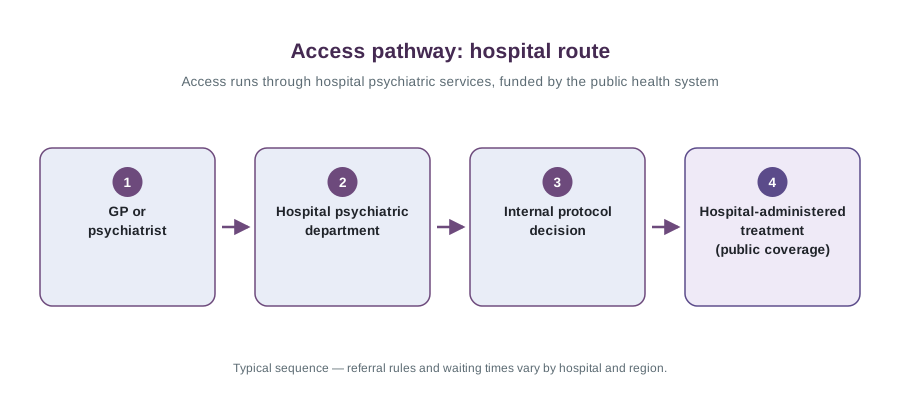
The regional variation warning: Formal financing criteria are national; implementation is not. Each autonomous community (and often each hospital pharmacy commission) decides how actively to run an esketamine program, how many patients to take, and how the internal protocol interprets "three failed strategies." In practice this means:
- Two patients with identical histories can face completely different waits depending on region;
- Some hospitals require their own case review board sign-off on each patient;
- If your local hospital has no program, ask your psychiatrist about referral to a reference hospital elsewhere in your community, or in another one.
Do not read a refusal at one hospital as a final answer for all of Spain. Document your treatment history thoroughly and ask where the nearest active program is. For how Spain's model compares with its neighbours (and what exceptional pathways exist elsewhere) see our Europe-wide reimbursement map.
Private ketamine clinics: legal, self-pay, big-city
Off-label ketamine from licensed physicians is legal, and private clinics, infusion-based and ketamine-assisted psychotherapy, operate mainly in Barcelona, Madrid and Mallorca (Mallorca hosts one of Europe's larger KAP providers, Eulas Clinics). Prices vary widely with the level of psychotherapy included; full KAP programs cost thousands of euros. Verify the physician's college registration (colegiado number) and the facility's healthcare authorization, and use our clinic-choice checklist before paying. If what you are searching for is integration support around a psychedelic experience (the therapy layer rather than the medicine) our Spain integration guide explains what legally exists and how to verify a licensed psychologist through the colegio registries. A reputable clinic takes a psychiatric and cardiovascular history before taking your money, has a physician present during sessions, and measures outcomes. To see who is listed near you, browse providers in Spain.
Psilocybin and MDMA: research participation only
Psilocybin, MDMA and other classic psychedelics remain controlled, investigational substances in Spain with no medical-access or reimbursement route: anyone offering them commercially as therapy is operating illegally. Two caveats are worth knowing:
- Spanish hospital sites took part in atai/Beckley's BPL-003 (5-MeO-DMT) Phase 2b study for treatment-resistant depression (NCT05870540), run across Australia, Germany, Poland, Spain, the UK and the US. Enrollment completed in March 2025 and positive topline results were announced in July 2025, so this study is no longer recruiting, and Phase 3 planning is underway with regulators. New Spanish sites may open when Phase 3 starts; watch the registries.
- The AEMPS special-situations pathway can, case by case, support access to an investigational medicine, but as Blossom's Spain report notes, it is not a general psilocybin, MDMA or 5-MeO-DMT access program, and no Spanish compassionate-access program for classic psychedelics exists as of mid-2026.
If this route matters to you, the realistic option is trial participation: our trials guide explains how to search and what participation involves.
Clinical trials in Spain
Spain is a serious research jurisdiction: Blossom tracks 24 psychedelic trials connected to Spain, 4 of them active, spanning academic ketamine and psilocybin research at hospital sites and international commercial programs such as BPL-003. Barcelona's academic hospitals have a long record in psychiatric and early psychedelic research, which is why new international programs tend to include Spanish sites. Participation is free and legal, but screening is strict, placebo or low-dose control arms are common, and enrolment is never guaranteed. See the trials guide for how phases, placebo and consent work, and search ClinicalTrials.gov and the EU CTIS registry for current Spanish listings.
What to expect in treatment
Medically reviewed by Dr. Amy Reichelt, PhD, 31 July 2026: this section and the risks section below.
These routes share a shape (medical screening, supervised administration, structured follow-up), but they are not interchangeable: the indication, the schedule, the staffing and the strength of the evidence all differ depending on whether you are prescribed Spravato (esketamine), given ketamine, or entering a legal psychedelic-assisted therapy route, where your country has one. What every route has in common is where it starts. Treatment begins with a screening appointment: the clinician reviews your psychiatric and medication history, checks your cardiovascular health and current medicines, and confirms the diagnosis before anything is scheduled. This is also where contraindications are caught.
On a Spravato day you self-administer the nasal spray in the practice or clinic under supervision, then stay for an observation period of roughly two hours while staff monitor blood pressure, heart rate, sedation, dissociation, breathing and overall recovery. Dissociation, dizziness, sedation, nausea and a temporary rise in blood pressure are common (though they do not occur in everyone), and settle as the drug clears. You must not drive, operate machinery or undertake anything hazardous until the following day, after a night's sleep, so arrange transport home. Induction is typically more frequent at first and then tapers based on measured response. Under the European label, Spravato for treatment-resistant depression is taken alongside a continuing oral SSRI or SNRI antidepressant.
A ketamine infusion for depression is an off-label use of the drug. It is usually given intravenously over about 40 minutes, with vital-sign and psychological monitoring and a recovery period afterwards. Some services offer ketamine-assisted psychotherapy (KAP), which wraps the dosing in preparation and integration sessions with a therapist; others provide ketamine as a medical antidepressant treatment with no psychotherapy component at all, which is worth establishing before you book. Where a legal psychedelic-assisted therapy route exists, and what that route is depends on the country: a clinical trial in most, a regulated programme or compassionate-use scheme in a few; dosing days are long and closely supervised by trained clinical staff, and sit inside a broader plan of preparation, general psychiatric care and integration. In every setting the medicine is one part of the plan: screening, monitoring and follow-up reduce risk but cannot eliminate it, and psychotherapy or integration may help you make sense of what the treatment brings up and apply it afterwards.
Risks and who should not start
These treatments are generally well tolerated under supervision, but they are not for everyone, which is exactly what screening is for. Common, transient effects during or shortly after a session include dissociation (a detached, dreamlike feeling), nausea, mild perceptual changes, and a short-lived rise in blood pressure and heart rate; these resolve as the drug is metabolised. Treatment may be inappropriate, or require particular caution and specialist evaluation, when any of the following apply:
- Uncontrolled hypertension or significant cardiovascular instability, including a history of aneurysmal vascular disease. This is a contraindication for Spravato, because of the temporary rise in blood pressure; the other treatments carry their own cardiovascular assessment.
- A personal or family history of psychosis or bipolar disorder: a particular caution for classic psychedelics such as psilocybin, which legal programmes screen for carefully.
- Pregnancy or breastfeeding.
- Current uncontrolled substance use, a history of ketamine misuse, or a high risk of compulsive use: any of these may make treatment inappropriate or require specialist assessment.
A responsible provider screens for all of these before the first dose. Careful screening, monitoring and follow-up reduce risk; they do not remove it. If a clinic is willing to treat you without that assessment, treat it as a warning sign; see our clinic-choice guide. To see who is listed near you, browse providers in Spain.
Reviewer's note. Ketamine, Spravato (esketamine) and psilocybin-assisted therapies share common elements such as screening, supervision and follow-up, but they should not be presented as interchangeable. Each has distinct indications, contraindications, monitoring requirements and levels of evidence. Spravato follows a regulated treatment pathway, while IV ketamine is generally used off-label and psilocybin therapies remain largely investigational. Importantly, careful screening and clinical monitoring reduce risk but do not eliminate it.
— Dr. Amy Reichelt, PhD, neuroscientist, chartered psychologist and psychotherapist, PsyAccess medical reviewers
Frequently asked questions
Who decides whether I get Spravato: my psychiatrist or the hospital?
Both. Your psychiatrist documents the failed strategies and refers you; the hospital team (often with its pharmacy commission) applies the financing criteria and its internal protocol before treatment starts.
Does it matter which autonomous community I live in?
Yes, more than it should. Programs, waits and internal rules differ by region and hospital. If your region has no active program, ask explicitly about referral to a reference hospital.
Are private ketamine clinics in Spain legal?
Yes, when run by licensed physicians in authorized healthcare facilities, prescribing off-label. Verify registrations before paying: quality and screening standards vary.
Is psilocybin or MDMA therapy available in Spain?
Only inside clinical trials. No Spanish compassionate-access program for classic psychedelics exists as of mid-2026, and the AEMPS special-situations pathway is a case-by-case mechanism for investigational medicines, not a general access route.
Can I still join the BPL-003 study?
Not the Phase 2b: it completed enrollment in March 2025 and reported positive topline results in July 2025. Phase 3 planning is underway; watch ClinicalTrials.gov and the EU CTIS registry for new Spanish sites.
How long is a session, and can I drive afterwards?
Budget most of a morning or afternoon: a short administration plus a roughly two-hour observation for Spravato at the hospital, or a 40–60 minute infusion plus recovery at a private clinic. You must not drive until the next day, after a restful sleep, so plan a lift home.
Coming from another country? Whether a clinic will take a non-resident self-pay patient, what a Spravato induction schedule means for a visitor, and where cross-border treatment actually works: ketamine & psychedelic therapy in Europe for international patients.
Sources
- CIMA — AEMPS medicines information center
- Ministerio de Sanidad
- EMA: Spravato product information
- Eulas Clinics: ketamine therapy pricing
- Blossom: Spain country report
- Psychedelic Alpha: Worldwide psychedelic laws tracker
- ClinicalTrials.gov: NCT05870540 — BPL-003 Phase 2b in treatment-resistant depression (Spanish sites)
- atai/Beckley: Positive topline results from the BPL-003 Phase 2b study (July 2025)
This guide is for general information only and is not medical advice, a diagnosis, or a recommendation of any treatment. Regulations and reimbursement rules change; always verify current requirements with your hospital and regional health service and discuss your options with a licensed clinician who knows your history. If you are in crisis, contact your local emergency number (in Spain: 112, or the 024 crisis line) immediately.
This guide awaits review by a licensed medical professional.