If you are looking into psychedelic-assisted treatment in Norway (for yourself or for someone close to you), the country holds a distinction no other has: since 25 August 2025, its public health system funds intravenous racemic ketamine for treatment-resistant depression, a world first. That makes Norway one of the few places in Europe where the strongest available route is the public one. This guide explains how a patient actually gets into that pathway, what the private clinics charge, why Spravato took a different path here, and where psilocybin and MDMA honestly stand. You can begin orienting yourself with our eligibility check.
TL;DR Norway's Beslutningsforum decided on 25 August 2025 that generic IV ketamine may be used and publicly funded for treatment-resistant depression: the first national decision of its kind anywhere. Treatment happens in the public specialist service only (hospitals and DPS centres), requires written consent acknowledging off-label use, includes registry or study follow-up, and will be re-evaluated by the end of 2028. The route in: your fastlege refers you to specialist mental health care. Spravato was rejected three times and is not funded. Two Oslo private clinics offer legal self-pay ketamine treatment. Psilocybin and MDMA are research-only, with no recruiting Norwegian trial for either in July 2026.
At a glance
| Route | Substance | Status in Norway | Who qualifies | Cost |
|---|---|---|---|---|
| Public IV ketamine | Racemic ketamine (off-label) | World-first national public funding since 25 August 2025 | Treatment-resistant depression, confirmed in the public specialist service | Publicly funded; standard specialist-care co-payments toward the frikort ceiling |
| Private ketamine clinics | Racemic ketamine (off-label) | Legal; self-pay clinics in Oslo (and Trondheim) | Clinic screening: depression incl. TRD, anxiety disorders, PTSD; 18+ | Roughly NOK 4,250–7,590 per session; programmes about NOK 12,750–47,640 |
| Esketamine (Spravato) | Esketamine | Not publicly funded, rejected three times (2021–2022) | – | – |
| Psilocybin therapy | Psilocybin | Research only; no Norwegian trial recruiting | – | – |
| MDMA therapy | MDMA | Research only; Norwegian studies completed, none recruiting | – | – |
| Clinical trials | Ketamine | One recruiting study (Tromsø) | Study-specific criteria | Free |
Full coverage details: Is ketamine publicly funded in Norway? · How the four Nordic systems compare: Esketamine and ketamine therapy in Scandinavia
The world first: publicly funded IV ketamine for treatment-resistant depression
On 25 August 2025, Beslutningsforum for nye metoder (the body that decides which treatments Norway's public specialist health service adopts) decided that ketamine may be used to treat treatment-resistant depression, effective the same day (Nye Metoder, ID2022_018). No other country funds generic racemic ketamine for depression at the national level; Psychedelic Alpha called it a world first the morning it happened. The proposal originally came from Sykehuset Østfold, the hospital trust whose clinicians had built the Norwegian evidence and protocol base for years.
The decision comes with conditions that shape what treatment looks like in practice:
- Public specialist service only. Until more is known about long-term effects, treatment should take place in hospitals or DPS centres (distriktspsykiatriske sentre: the local units of public specialist mental health care), not in private practice.
- Informed consent about off-label use. Ketamine is not licensed for depression, so patients must be told the treatment is outside the approved indication, why, and what that means, before starting.
- Registry or study follow-up. Every treated patient is followed through a registry or clinical study until the long-term evidence matures.
- A built-in expiry check. The decision will be re-evaluated by the end of 2028, and in April 2026 the ordering forum asked the medicines agency DMP to run an updated literature search on effects lasting beyond seven days, so the evidence review is already in motion.
How you actually get in
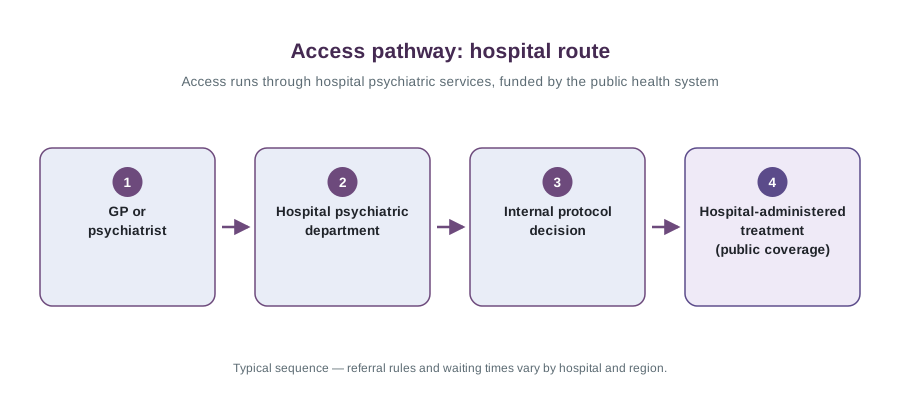
The pathway follows the standard Norwegian referral chain, and knowing its shape saves months:
- Start with your fastlege (regular GP). Ask directly about referral to specialist mental health care for treatment-resistant depression, and bring a written history of every antidepressant and therapy you have tried: substance, dose, duration, outcome. That document counts for more than anything else in the process.
- The referral goes to a DPS or hospital psychiatric department, which assesses whether you meet the criteria for specialist care and whether your depression counts as treatment-resistant, in practice, documented failure of adequate previous treatments in the current episode.
- The local treatment team decides. The national decision entitles appropriate patients across the country to this treatment regardless of where they live, but each hospital trust builds its own capacity, so what is offered, and how soon, varies by region. If your local unit has no programme yet, ask the assessing psychiatrist what the nearest offering unit is.
- Treatment and follow-up happen under the conditions above: supervised infusions in a hospital or DPS setting, with consent paperwork and registry enrolment as part of the package.
Cost: Within the public specialist service you pay at most the standard outpatient co-payments, which count toward the annual frikort exemption ceiling, after that, care is free for the rest of the year. Compare this with what every other European system pays for in our Europe-wide reimbursement map.
Spravato: rejected three times – and why that matters less here
Esketamine nasal spray (Spravato) is the branded, licensed cousin of generic ketamine, and most of continental Europe reimburses it. Norway went the other way. Beslutningsforum said no three times (26 April 2021, 25 October 2021 and 18 October 2022) citing low-quality documentation, uncertain clinical benefit and a price too high for the evidence (Nye Metoder, ID2019_116). In April 2025 the ordering forum declined to commission a new assessment, concluding that nothing in the manufacturer's submission would change the outcome at the chosen price.
For patients, the practical meaning is simple: there is no funded Spravato route in Norway, and the public system has channelled this patient group toward the generic IV ketamine pathway instead. If you have read about Spravato reimbursement elsewhere in Europe, do not expect the same here, but the treatment need it serves is exactly what the August 2025 decision covers.
Private ketamine clinics: legal, self-pay, mostly Oslo
Alongside the public route, private ketamine treatment is legal and available without a referral. Two established clinics are listed in our Norway catalog:
Axonklinikken (Oslo, with a Trondheim site) has offered ketamine-assisted psychotherapy since 2018: each treatment combines ketamine with about 40 minutes of psychotherapy from a fixed therapist, with a doctor always at the clinic. Published prices: a startup consultation at NOK 2,900, sessions at NOK 7,590, and complete four-to-six-session programmes from about NOK 32,460 to 47,640, with evaluation and follow-up calls at 3, 6 and 12 months included. The clinic states most patients are recommended a programme of roughly NOK 35,000–50,000, and that private treatment insurance often covers the talk-therapy component.
Synapseklinikken (Oslo) offers intravenous low-dose ketamine built on the Sykehuset Østfold protocol: an obligatory psychologist assessment (NOK 1,750) and medical examination (NOK 990), then typically six 120-minute infusion sessions at NOK 4,250 each over about three weeks. Published packages run from NOK 12,750 (a three-infusion follow-up course) to NOK 38,490, with the standard start-up-plus-six-infusions pathway at NOK 29,990 and free follow-up calls at 3, 6 and 12 months. The clinic itself states plainly that the infusion is not covered by Helfo or standard health insurance: treatment is paid privately.
Both clinics screen before treating: psychiatric and medical assessment first, treatment decision second. That order is what separates a legitimate clinic from a questionable one. Our Europe-wide reimbursement map explains why the private-versus-public cost gap looks the way it does across the continent.
Psilocybin: research only
Psilocybin is a controlled substance in Norway with no medical-access framework: no compassionate use programme, authorised clinic or funded route. Unlike Czechia or Switzerland, Norway has not created any legal delivery mechanism, and as of July 2026 no Norwegian psilocybin trial is recruiting. Anyone offering psilocybin therapy commercially in Norway today is operating illegally. If psilocybin research matters to you, the realistic option is trial sites elsewhere in Europe: our trials guide explains how to search registries and what participation actually involves.
MDMA: research only, with real history
Norway has genuine MDMA research history: Sykehuset Østfold ran an open-label study of MDMA-assisted psychotherapy for PTSD and a Phase 2 feasibility study in major depressive disorder, both now completed, and a planned long-term follow-up study was withdrawn (Blossom's Norway report tracks all five Norwegian trials). But history is not access: MDMA remains a controlled substance with no medical route, and no Norwegian MDMA trial is recruiting as of July 2026. The remaining options are watching the registries or considering trial sites abroad.
Clinical trials in Norway
The research route is narrow right now. Blossom tracks five trials connected to Norway, and the one currently recruiting is KeDA: a Phase 1/2 study of ketamine for combined depression and alcohol use disorder at the University Hospital of North Norway in Tromsø (NCT06090422). Participation in any trial is free and legal, with strict screening and no guarantee of enrolment. Because the public ketamine decision requires registry or study follow-up, some patients will also encounter research participation as part of standard public treatment. See the trials guide for how phases, placebo and consent work, and search ClinicalTrials.gov for current Norwegian listings.
What to expect in treatment
Medically reviewed by Dr. Amy Reichelt, PhD, 31 July 2026: this section and the risks section below.
These routes share a shape (medical screening, supervised administration, structured follow-up), but they are not interchangeable: the indication, the schedule, the staffing and the strength of the evidence all differ depending on whether you are prescribed Spravato (esketamine), given ketamine, or entering a legal psychedelic-assisted therapy route, where your country has one. What every route has in common is where it starts. Treatment begins with a screening appointment: the clinician reviews your psychiatric and medication history, checks your cardiovascular health and current medicines, and confirms the diagnosis before anything is scheduled. This is also where contraindications are caught.
On a Spravato day you self-administer the nasal spray in the practice or clinic under supervision, then stay for an observation period of roughly two hours while staff monitor blood pressure, heart rate, sedation, dissociation, breathing and overall recovery. Dissociation, dizziness, sedation, nausea and a temporary rise in blood pressure are common (though they do not occur in everyone), and settle as the drug clears. You must not drive, operate machinery or undertake anything hazardous until the following day, after a night's sleep, so arrange transport home. Induction is typically more frequent at first and then tapers based on measured response. Under the European label, Spravato for treatment-resistant depression is taken alongside a continuing oral SSRI or SNRI antidepressant.
A ketamine infusion for depression is an off-label use of the drug. It is usually given intravenously over about 40 minutes, with vital-sign and psychological monitoring and a recovery period afterwards. Some services offer ketamine-assisted psychotherapy (KAP), which wraps the dosing in preparation and integration sessions with a therapist; others provide ketamine as a medical antidepressant treatment with no psychotherapy component at all, which is worth establishing before you book. Where a legal psychedelic-assisted therapy route exists, and what that route is depends on the country: a clinical trial in most, a regulated programme or compassionate-use scheme in a few; dosing days are long and closely supervised by trained clinical staff, and sit inside a broader plan of preparation, general psychiatric care and integration. In every setting the medicine is one part of the plan: screening, monitoring and follow-up reduce risk but cannot eliminate it, and psychotherapy or integration may help you make sense of what the treatment brings up and apply it afterwards.
Risks and who should not start
These treatments are generally well tolerated under supervision, but they are not for everyone, which is exactly what screening is for. Common, transient effects during or shortly after a session include dissociation (a detached, dreamlike feeling), nausea, mild perceptual changes, and a short-lived rise in blood pressure and heart rate; these resolve as the drug is metabolised. Treatment may be inappropriate, or require particular caution and specialist evaluation, when any of the following apply:
- Uncontrolled hypertension or significant cardiovascular instability, including a history of aneurysmal vascular disease. This is a contraindication for Spravato, because of the temporary rise in blood pressure; the other treatments carry their own cardiovascular assessment.
- A personal or family history of psychosis or bipolar disorder: a particular caution for classic psychedelics such as psilocybin, which legal programmes screen for carefully.
- Pregnancy or breastfeeding.
- Current uncontrolled substance use, a history of ketamine misuse, or a high risk of compulsive use: any of these may make treatment inappropriate or require specialist assessment.
A responsible provider screens for all of these before the first dose. Careful screening, monitoring and follow-up reduce risk; they do not remove it. If a clinic is willing to treat you without that assessment, treat it as a warning sign; see our clinic-choice guide. To see who is listed near you, browse providers in Norway.
Reviewer's note. Ketamine, Spravato (esketamine) and psilocybin-assisted therapies share common elements such as screening, supervision and follow-up, but they should not be presented as interchangeable. Each has distinct indications, contraindications, monitoring requirements and levels of evidence. Spravato follows a regulated treatment pathway, while IV ketamine is generally used off-label and psilocybin therapies remain largely investigational. Importantly, careful screening and clinical monitoring reduce risk but do not eliminate it.
— Dr. Amy Reichelt, PhD, neuroscientist, chartered psychologist and psychotherapist, PsyAccess medical reviewers
Frequently asked questions
Is ketamine treatment for depression really publicly funded in Norway now?
Yes. Beslutningsforum decided on 25 August 2025 that IV ketamine may be used for treatment-resistant depression in the public specialist service, effective immediately. You pay at most standard specialist-care co-payments toward the frikort ceiling. The decision requires off-label consent and registry or study follow-up, and will be re-evaluated by the end of 2028.
How do I get into the public pathway?
Through your fastlege: ask for a referral to a DPS or hospital psychiatric department for treatment-resistant depression, and bring a written record of every treatment you have tried. The specialist team confirms eligibility and decides per its local protocol. Availability varies by hospital trust while capacity builds, so ask the assessing psychiatrist what the nearest offering unit is.
Why is Spravato not available when generic ketamine is?
Beslutningsforum rejected Spravato three times between 2021 and 2022 over evidence quality and price, and declined a reassessment in 2025. The public system chose to fund the inexpensive generic compound under controlled conditions instead: the reverse of most European countries, which reimburse Spravato and leave IV ketamine unfunded.
Do the private clinics require a referral?
No. Both Axonklinikken and Synapseklinikken accept self-referral, offer a free introductory phone call, and require their own medical and psychological assessment before any treatment decision. Expect published package prices from roughly NOK 12,750 to 47,640 depending on programme length, paid privately.
Can I get psilocybin or MDMA therapy in Norway?
Not outside research, and as of July 2026 no Norwegian psilocybin or MDMA trial is recruiting. Norway has no compassionate-use or medical-access framework for either substance. Watch the registries for new studies, or look at trial sites elsewhere in Europe.
What happens in 2028?
The public funding decision is conditional: registry and study data on long-term effects will feed a re-evaluation due by the end of 2028, and an updated evidence review was already commissioned in April 2026. The pathway could be confirmed, tightened or changed, one more reason the system documents every treated patient.
Coming from another country? Whether a clinic will take a non-resident self-pay patient, what a Spravato induction schedule means for a visitor, and where cross-border treatment actually works: ketamine & psychedelic therapy in Europe for international patients.
Sources
- Nye Metoder: Ketamin — ID2022_018, Beslutningsforum decision of 25 August 2025
- Beslutningsforum for nye metoder: meeting protocol, 25 August 2025 (PDF)
- Psychedelic Alpha: Norway Approves Public Funding for Generic Ketamine in Treatment-Resistant Depression (25 August 2025)
- Nye Metoder: Esketamin (Spravato) — ID2019_116, decisions of 26 April 2021, 25 October 2021 and 18 October 2022
- Blossom: Norway country report
- Blossom: Medical access in Norway
- Psychedelic Alpha: Worldwide psychedelic laws tracker
- Axonklinikken — treatment programme and published prices
- Synapseklinikken — treatment, prices and coverage statements
- ClinicalTrials.gov: NCT06090422 — Ketamine for Combined Depression and Alcohol Use Disorder (KeDA), Tromsø
This guide is for general information only and is not medical advice, a diagnosis, or a recommendation of any treatment. Norway's public ketamine pathway is new and its rules and capacity are still developing; always verify current requirements with your fastlege, the treating hospital or DPS, and check Nye Metoder for decision updates. If you are in crisis, contact your local emergency number or a crisis line immediately.
This guide awaits review by a licensed medical professional.