If you are considering psychedelic-assisted treatment in Sweden (for yourself or for someone close to you), the picture in July 2026 is defined less by law than by restraint. The medicines exist, the system has assessed them, and the national advisory body has told the regions to hold back. The result is a system in which the formally approved route is deliberately narrow, the off-label route quiet and self-paid, and the research route, unusually for Europe, one of the strongest on offer. This guide covers who qualifies for each route, how to start, what it costs, and what to realistically expect; you can begin orienting yourself with our eligibility check.
TL;DR Spravato (esketamine) is legal in Sweden but the NT Council recommends "strongly restrained" (kraftigt återhållsam) use: its recommendation, first issued 30 June 2021 and revised 6 November 2024, reserves the spray for patients who have tried roughly four other treatment alternatives, and each region decides its own funding, so availability varies across the country. Off-label racemic ketamine for depression exists in some specialist and private settings; the only officially published tariff is Region Jönköping's 2,089–6,269 SEK per session, and named private clinics publish no prices. Psilocybin and MDMA have no medical route, but psilocybin trials are recruiting in five Swedish cities (for cancer-related depression and for anorexia nervosa), which makes the research route unusually open here.
At a glance
| Route | Substance | Status in Sweden | Who qualifies | Cost |
|---|---|---|---|---|
| Esketamine (Spravato) | Esketamine | Legal; NT Council advises strongly restrained use (rev. 11/2024); region-by-region funding | Treatment-resistant depression, in practice after roughly four failed alternatives; specialist psychiatry decides | Public patient fees within the high-cost ceiling where a region funds it |
| Off-label ketamine | Racemic ketamine | Legal off-label use in some specialist and private settings | Clinic or department screening; typically documented treatment resistance | Region tariff (Jönköping, published): 2,089–6,269 SEK per session by dose; private prices not published |
| Psilocybin therapy | Psilocybin | Research only, but trials recruiting in five cities | Study-specific criteria (cancer-related depression; anorexia nervosa) | Free within a trial |
| MDMA therapy | MDMA | Research only; no Swedish trial exists | – | – |
| Clinical trials | Psilocybin, ketamine, esketamine | Several recruiting studies | Study-specific criteria | Free |
Full coverage details: Is Spravato reimbursed in Sweden? · How the four Nordic systems compare: Esketamine and ketamine therapy in Scandinavia
Esketamine (Spravato): legal, assessed – and deliberately held back
Sweden never rejected Spravato the way England or Norway did. Instead, the NT Council (NT-rådet) (the body that advises all 21 regions on new therapies) issued a recommendation on 30 June 2021, revised on 6 November 2024, that use should be kraftigt återhållsam: strongly restrained (Samverkanläkemedel). The reasoning is documented uncertainty about long-term benefit and side effects relative to price. In practice the recommendation means Spravato only becomes relevant after a run of better-documented options (roughly four treatment alternatives, counting antidepressants, augmentation and, where appropriate, ECT) has been tried and failed.
Two structural facts follow from this, and they decide what you can actually get:
- Funding is regional. The NT Council advises; each region decides. Some regions have published local care routines for Spravato in treatment-resistant depression (Region Skåne, for example, maintains a detailed clinical protocol), while others fund little or none. The same diagnosis can meet a different answer in a different county.
- Delivery is specialist-only. Spravato is a clinic-administered (rekvisition) medicine given in specialist psychiatry with post-dose observation, never dispensed for home use. Your entry point is a psychiatrist, usually via referral from primary care.
How to start: Ask your vårdcentral for a referral to specialist psychiatry, or approach a psychiatric clinic directly where your region allows self-referral (egenremiss). The practical currency, as everywhere in Europe, is a written treatment history: every antidepressant and augmentation tried in the current episode, with dose, duration and outcome. In a system built on restraint, that document is your case. Where the region funds treatment, you pay ordinary patient fees that count toward the national high-cost ceiling (högkostnadsskydd).
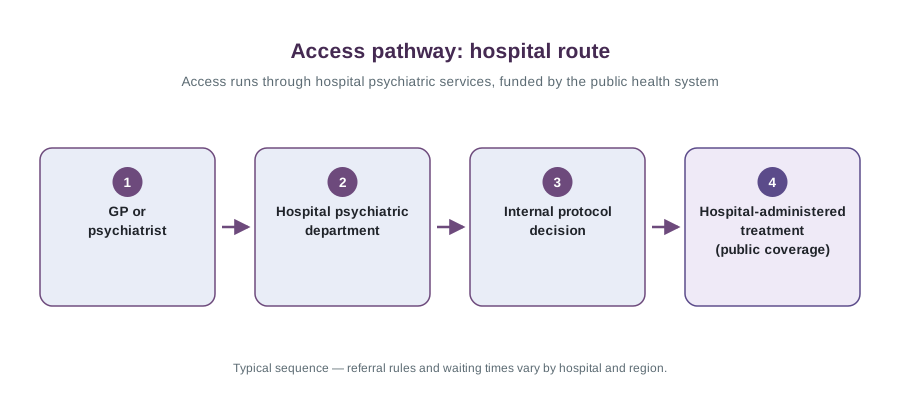
Waiting and realism: Even in funding regions, volumes are small and clinics few. Expect the assessment chain (referral, specialist evaluation, internal decision) to take months rather than weeks; your documentation will be read against the roughly-four-alternatives bar. How Sweden's restraint compares with its neighbours is mapped in our Europe-wide reimbursement guide.
Off-label ketamine: quiet, legal, mostly self-paid
Racemic ketamine is an authorised anaesthetic in Sweden, and prescribing it off-label for depression is legal medical practice. What Sweden lacks is any national funding decision for it: there is no Norwegian-style pathway here. In practice, off-label ketamine treatment for depression exists in two forms:
- Some public specialist settings use ketamine within hospital psychiatry, in connection with ECT units, research programmes or individual clinical decisions. Access is at the treating department's discretion and cannot be applied for from outside; if you are already in specialist care, it is a conversation to have with your psychiatrist.
- A small private market offers ketamine infusions for treatment-resistant depression on a self-pay basis, but no named Swedish clinic publishes a price list: earlier figures circulating online trace back to a commercial aggregator, not to providers. The only officially published tariff is Region Jönköping's dose-based 2,089–6,269 SEK per session (protocol capped at roughly ten patients per year). Private treatment is not covered by regional funding or the high-cost ceiling.
Screening comes first in any legitimate setting: psychiatric history, cardiovascular check, medication review, then a treatment decision. A clinic that skips that order is a warning sign, whatever its prices.
Psilocybin: research only – but the trials are real
Psilocybin is a controlled narcotic in Sweden with no medical-access route: no compassionate-use programme, no authorised clinics, and no reimbursement. What Sweden does have, more than most of Europe, is recruiting research. As of July 2026, two psilocybin trials are open:
- CAPSI (NCT06319378), a Phase 2 study of a single 25 mg psilocybin dose for cancer-related major depression, led from Northern Stockholm Psychiatry and recruiting at sites in Stockholm, Gothenburg, Uppsala and Örebro.
- A Region Skåne study in Lund (NCT07169747) of two psilocybin doses with psychological support in young adults with anorexia nervosa, one of very few anorexia psilocybin trials anywhere.
Participation is free, legal and strictly screened; enrolment is never guaranteed, and placebo or low-dose comparison arms are part of the design. If your situation matches either study population, this is the one route in Sweden where psilocybin therapy is actually happening; browse trial sites in Sweden and see our trials guide for how participation works. Anyone selling psilocybin therapy commercially in Sweden is operating illegally, including retreat formats.
MDMA: not available in any form
MDMA is a controlled substance in Sweden with no medical route, no compassionate-use framework, and, unlike Norway or Finland's neighbours, no Swedish MDMA trial history to point to: Blossom's tracking of Swedish studies shows esketamine, ketamine and psilocybin, not MDMA. As of July 2026 no Swedish MDMA study is recruiting or planned in the public registries. If MDMA-assisted therapy matters to you, the realistic option is trial sites elsewhere in Europe: our trials guide explains how to search. Anyone offering MDMA therapy commercially in Sweden today is breaking the law.
Clinical trials in Sweden
The research route deserves its own summary, because it is Sweden's strongest card. Blossom tracks eight trials connected to Sweden, and the recruiting set in July 2026 spans three compounds: the two psilocybin studies above, and a Phase 2 trial of add-on oral slow-release ketamine in major depression that began in March 2026. Karolinska Institutet anchors much of the ecosystem, including PET-imaging psilocybin research. Sweden also hosted sites in the international esketamine Phase 3 programme (ESCAPE-TRD, SUSTAIN), which is part of why the system's evidence standards are so explicit. Participation is free and legal, with strict screening; see the trials guide for phases, placebo and consent, and search ClinicalTrials.gov for current Swedish listings.
What to expect in treatment
Medically reviewed by Dr. Amy Reichelt, PhD, 31 July 2026: this section and the risks section below.
These routes share a shape (medical screening, supervised administration, structured follow-up), but they are not interchangeable: the indication, the schedule, the staffing and the strength of the evidence all differ depending on whether you are prescribed Spravato (esketamine), given ketamine, or entering a legal psychedelic-assisted therapy route, where your country has one. What every route has in common is where it starts. Treatment begins with a screening appointment: the clinician reviews your psychiatric and medication history, checks your cardiovascular health and current medicines, and confirms the diagnosis before anything is scheduled. This is also where contraindications are caught.
On a Spravato day you self-administer the nasal spray in the practice or clinic under supervision, then stay for an observation period of roughly two hours while staff monitor blood pressure, heart rate, sedation, dissociation, breathing and overall recovery. Dissociation, dizziness, sedation, nausea and a temporary rise in blood pressure are common (though they do not occur in everyone), and settle as the drug clears. You must not drive, operate machinery or undertake anything hazardous until the following day, after a night's sleep, so arrange transport home. Induction is typically more frequent at first and then tapers based on measured response. Under the European label, Spravato for treatment-resistant depression is taken alongside a continuing oral SSRI or SNRI antidepressant.
A ketamine infusion for depression is an off-label use of the drug. It is usually given intravenously over about 40 minutes, with vital-sign and psychological monitoring and a recovery period afterwards. Some services offer ketamine-assisted psychotherapy (KAP), which wraps the dosing in preparation and integration sessions with a therapist; others provide ketamine as a medical antidepressant treatment with no psychotherapy component at all, which is worth establishing before you book. Where a legal psychedelic-assisted therapy route exists, and what that route is depends on the country: a clinical trial in most, a regulated programme or compassionate-use scheme in a few; dosing days are long and closely supervised by trained clinical staff, and sit inside a broader plan of preparation, general psychiatric care and integration. In every setting the medicine is one part of the plan: screening, monitoring and follow-up reduce risk but cannot eliminate it, and psychotherapy or integration may help you make sense of what the treatment brings up and apply it afterwards.
Risks and who should not start
These treatments are generally well tolerated under supervision, but they are not for everyone, which is exactly what screening is for. Common, transient effects during or shortly after a session include dissociation (a detached, dreamlike feeling), nausea, mild perceptual changes, and a short-lived rise in blood pressure and heart rate; these resolve as the drug is metabolised. Treatment may be inappropriate, or require particular caution and specialist evaluation, when any of the following apply:
- Uncontrolled hypertension or significant cardiovascular instability, including a history of aneurysmal vascular disease. This is a contraindication for Spravato, because of the temporary rise in blood pressure; the other treatments carry their own cardiovascular assessment.
- A personal or family history of psychosis or bipolar disorder: a particular caution for classic psychedelics such as psilocybin, which legal programmes screen for carefully.
- Pregnancy or breastfeeding.
- Current uncontrolled substance use, a history of ketamine misuse, or a high risk of compulsive use: any of these may make treatment inappropriate or require specialist assessment.
A responsible provider screens for all of these before the first dose. Careful screening, monitoring and follow-up reduce risk; they do not remove it. If a clinic is willing to treat you without that assessment, treat it as a warning sign; see our clinic-choice guide. To see who is listed near you, browse providers in Sweden.
Reviewer's note. Ketamine, Spravato (esketamine) and psilocybin-assisted therapies share common elements such as screening, supervision and follow-up, but they should not be presented as interchangeable. Each has distinct indications, contraindications, monitoring requirements and levels of evidence. Spravato follows a regulated treatment pathway, while IV ketamine is generally used off-label and psilocybin therapies remain largely investigational. Importantly, careful screening and clinical monitoring reduce risk but do not eliminate it.
— Dr. Amy Reichelt, PhD, neuroscientist, chartered psychologist and psychotherapist, PsyAccess medical reviewers
Frequently asked questions
Can I actually get Spravato in Sweden?
Yes, but narrowly. The NT Council's recommendation (revised November 2024) advises strongly restrained use, in practice after roughly four failed treatment alternatives, and each region decides whether to fund it. You need a specialist psychiatry assessment and a documented treatment history; whether treatment follows depends on your region's stance and your clinic's protocol.
Why does availability depend on where I live?
Sweden's 21 regions each make their own funding decisions; the NT Council only advises them. Some regions have published Spravato care routines, others fund little or none. If your region says no, options are a second specialist opinion, a documented individual case, or the research route.
What does private ketamine treatment cost?
No named Swedish private clinic publishes a price list; the only official published tariff is Region Jönköping's dose-based 2,089–6,269 SEK per session. Private treatment sits outside the high-cost ceiling, so nothing is reimbursed. Ask for the full course price in writing before starting.
Can I join a psilocybin trial in Sweden?
If you match a study population, genuinely yes: CAPSI recruits people with cancer-related major depression in Stockholm, Gothenburg, Uppsala and Örebro, and a Lund study recruits young adults with anorexia nervosa. Screening is strict and enrolment is never guaranteed, but these are real, free, legal routes to supervised psilocybin treatment.
Is MDMA therapy available in Sweden?
No, not clinically, not in research. No Swedish MDMA trial exists, and no medical framework allows it. Trial sites elsewhere in Europe are the only legal option.
Does the high-cost ceiling cover any of this?
Public specialist care, including regionally funded Spravato, falls under ordinary patient fees and the high-cost ceiling. Private ketamine clinics and anything self-paid do not count toward it.
Coming from another country? Whether a clinic will take a non-resident self-pay patient, what a Spravato induction schedule means for a visitor, and where cross-border treatment actually works: ketamine & psychedelic therapy in Europe for international patients.
Sources
- Samverkanläkemedel (NT Council): Spravato (esketamin) — recommendation of 30 June 2021, revised 6 November 2024
- Läkartidningen: NT-rådet rekommenderar kraftigt återhållsam användning av Spravato (November 2021)
- TLV: Health-economic assessment of Spravato (esketamine) nasal spray (2020, PDF)
- Region Skåne: Spravato (esketamin) vid terapiresistent depression — regional care routine (PDF)
- Blossom: Sweden country report
- Blossom: Medical access in Sweden
- Psychedelic Alpha: Worldwide psychedelic laws tracker
- ClinicalTrials.gov: NCT06319378 — Cancer-related major depression treated with a single dose of psilocybin (CAPSI)
- ClinicalTrials.gov: NCT07169747 — Two psilocybin doses with psychological support in young adults with anorexia nervosa (Lund)
- EMA: Spravato (esketamine) EPAR
This guide is for general information only and is not medical advice, a diagnosis, or a recommendation of any treatment. Regional funding decisions and trial recruitment change; always verify current requirements with your region, your clinic, or a licensed clinician who knows your history. If you are in crisis, contact 112 or a crisis line immediately.
This guide awaits review by a licensed medical professional.