If you are considering psychedelic-assisted treatment in Poland — for yourself or for someone close to you — three legal routes exist in July 2026, and they differ sharply in how real they are today. One is fully funded and running through a dedicated National Health Fund program, one is a private self-pay market in the big cities, and everything beyond ketamine is limited to research. This guide covers who qualifies for each, how to start, what it costs, and what to realistically expect; you can begin orienting yourself with our eligibility check.
TL;DR Drug program B.147 ("Leczenie chorych na depresję lekooporną") has funded esketamine nasal spray since 2023. It covers adults 18–75 with moderate-to-severe depression that failed at least two antidepressants in the current episode, treated free of charge at designated program centers for up to 34 weeks; live first-appointment waiting times are published on the NFZ's national portal. Private off-label ketamine clinics operate in Warsaw, Wrocław and other large cities, fully self-pay. Psilocybin and MDMA therapy are not available outside research — Polish sites participated in the BPL-003 (5-MeO-DMT) Phase 2b program, and a publicly funded psilocybin trial is run by the Medical University of Warsaw.
At a glance
| Route | Substance | Status in Poland | Who qualifies | Cost |
|---|---|---|---|---|
| NFZ drug program B.147 | Esketamine (Spravato) | Funded since 2023; running at ~64 contracted centers | Adults 18–75, moderate-to-severe episode, at least two (but no more than five) failed antidepressants in the current episode, at least a second episode lasting 6+ months; bipolar disorder, psychotic symptoms and substance-dependence history excluded | Free (drug, visits, observation, monitoring) |
| Private ketamine clinic | Ketamine (off-label) | Legal; clinics in Warsaw, Wrocław and other large cities | Clinic's own medical screening, off-label decision by a physician | Self-pay; per-session pricing varies |
| Psilocybin therapy | Psilocybin | Research only — no medical access route | Study-specific criteria | Free within trials |
| MDMA therapy | MDMA | Research only; no Polish MDMA trial recruiting as of July 2026 | — | — |
| Clinical trials | Psilocybin, 5-MeO-DMT, ketamine, others | Polish sites active in international and domestic programs | Study-specific criteria | Free |
Esketamine via NFZ program B.147: the route that works today
Drug programs (programy lekowe) are how the NFZ funds expensive medicines under strict protocols. Within B.147, the drug, administration visits, observation and monitoring are all NFZ-funded — there is no co-payment for the medicine. It was the first drug program in Polish psychiatry.
The published criteria (programylekowe.pl, prof. Gałecki's patient guide):
- Age 18–75, depressive episode of moderate or severe intensity;
- No improvement after at least two different antidepressants at adequate dose and duration in the current episode — but no more than five tried;
- At least a second episode of depression, with the current episode lasting at least 6 months from the first medical visit for it;
- Exclusions include bipolar disorder, psychotic symptoms and a history of substance dependence.
Experts have publicly argued the criteria are too narrow — enrollment ran around 250 patients a year instead of the projected 1,000 — and revisions have been under discussion. Check the current wording with a program center before ruling yourself out: the person who decides is the qualifying psychiatrist, not a form on a website.
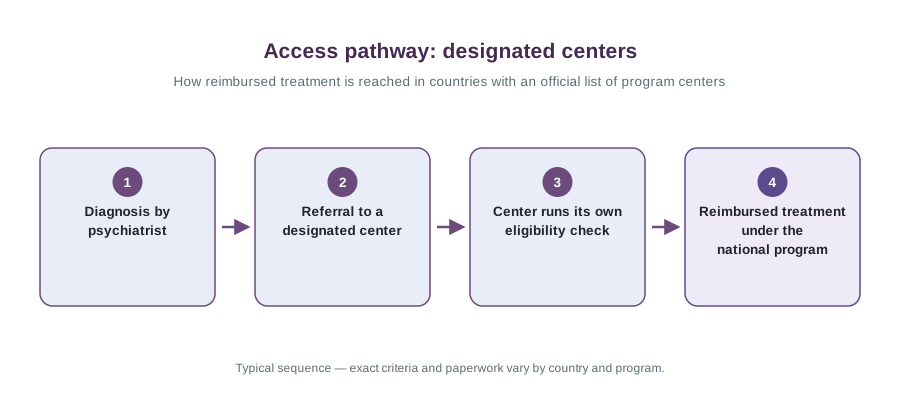
How to enroll. Gather your records first — diagnoses, every antidepressant tried in the current episode with doses and durations, hospitalizations. No referral is formally needed to see a psychiatrist in Poland, but records are essential. Then contact a program center directly: only sites contracted for B.147 can qualify patients, and around 64 facilities nationwide have joined the program. You may choose any of them, regardless of where you live — to see who is listed near you, browse providers in Poland. At the qualification visit a psychiatrist checks you against the criteria, orders baseline tests, and enrolls you in the NFZ system if eligible.
Waiting times are public. Every contracted facility reports its first available appointment to the NFZ. Check live waiting times in the national Informator o Terminach Leczenia or via pacjent.gov.pl; the NFZ patient hotline (800 190 590) can help locate the nearest center with the shortest queue. Waits vary sharply by region — big-city sites often have queues while some regional centers admit quickly, and since you can enroll anywhere in the country, comparing queues before your first call can save weeks.
Treatment itself is outpatient, in two phases: a four-week induction with two visits a week, then maintenance with tapering frequency, up to a maximum of 34 weeks. For how Poland's fully funded but narrow program compares with the rest of the continent, see our Europe-wide reimbursement map.
Private ketamine clinics: legal, self-pay, variable
If you fall outside the B.147 criteria — a first episode, for instance — esketamine is legal but self-paid and rarely offered privately. Some patients instead consider off-label ketamine infusions at private clinics, concentrated in Warsaw, Wrocław and other large cities. Off-label prescribing by a licensed physician is legal and standard practice, but screening quality and prices vary widely between clinics, and no insurer or NFZ funding applies.
Before paying, apply the checks from our clinic-choice guide: a reputable clinic takes a psychiatric and cardiovascular history before taking your money, has a physician present during sessions, monitors vital signs, and measures outcomes. A clinic willing to treat you without a psychiatric and cardiovascular assessment is a warning sign.
Psilocybin and MDMA: research participation only
Psilocybin and MDMA remain controlled substances in Poland with no medical-access or reimbursement route — anyone offering them commercially as therapy is operating illegally. What Poland does have is a growing research footprint:
- Polish sites took part in atai/Beckley's BPL-003 (5-MeO-DMT) Phase 2b study for treatment-resistant depression (NCT05870540), run across Australia, Germany, Poland, Spain, the UK and the US. The Gdańsk site, Centrum Badań Klinicznych PI-House, administered the first Schedule I psychedelic to patients in a Polish clinical study. Enrollment completed in March 2025 and positive topline results were announced in July 2025 — so this study is no longer recruiting, and Phase 3 planning is underway with regulators.
- A team at the Medical University of Warsaw received PLN 16 million from the Medical Research Agency (ABM) for a clinical trial of psilocybin — given alongside SSRIs or after their discontinuation — in drug-resistant depression, and more Polish centers have applied for approval of psilocybin research.
- No Polish MDMA trial is listed as recruiting as of July 2026.
If this route matters to you, watch the registries for new Polish studies — recruitment windows open and close quickly. Our trials guide explains how to search and what participation involves.
Clinical trials in Poland
Participation in a trial is free and legal, and Poland's role in international psychedelic programs is growing — commercial research sites such as PI-House in Gdańsk and MTZ Clinical Research in Warsaw have hosted psychedelic studies, alongside academic work at the Medical University of Warsaw. Screening is strict, placebo or low-dose control arms are common, and enrolment is never guaranteed. See the trials guide for how phases, placebo and consent work, and search ClinicalTrials.gov and the EU CTIS registry for current Polish listings; Blossom's Poland report tracks the country's research pipeline.
What to expect in treatment
Once qualified for B.147, the rhythm of care is predictable. Each visit follows the same pattern: a brief check of how you have been since the last session, then supervised self-administration of the nasal spray at the center, followed by an observation period of about two hours during which staff monitor your blood pressure, heart rate and how you feel. A dreamlike, detached sensation and a temporary rise in blood pressure are expected during this window and settle as the drug clears. You cannot drive afterwards, so arrange a ride home for every visit — during the four-week induction that means planning transport twice a week.
Esketamine in the program is combined with a continuing oral antidepressant, and the center tracks your response with structured assessments; whether treatment continues into the maintenance phase depends on measured improvement, not guesswork. Plan the practical side early: two visits a week of several hours each is a real commitment if you work or travel far to the center. Many patients find that adding psychotherapy alongside the program — arranged separately — helps the effect last, and clinicians typically recommend it.
A private ketamine session is usually built around an infusion given intravenously over about 40–60 minutes, with the same vital-sign monitoring and a recovery period afterwards; better clinics wrap the dosing in preparation and follow-up appointments. In every setting the medicine is one part of the plan — screening, monitoring and follow-up are what make it safe.
Risks and who should not start
Supervised (es)ketamine treatment is generally well tolerated, but it is not for everyone — which is what the qualification visit and baseline tests are designed to catch. Common, transient effects during or shortly after a session include dissociation, nausea, dizziness, mild perceptual changes, and a short-lived rise in blood pressure and heart rate; these resolve as the drug is metabolised. Treatment may be inappropriate, or require particular caution and specialist evaluation, when any of the following apply:
- Uncontrolled hypertension or significant cardiovascular instability, including a history of aneurysmal vascular disease, because of the temporary rise in blood pressure.
- Bipolar disorder or psychotic symptoms — these are explicit exclusions from the B.147 program, and a personal or family history of psychosis is a particular caution for classic psychedelics in trial settings.
- A history of substance dependence — also an explicit program exclusion.
- Pregnancy or breastfeeding.
The program's screening covers all of these before the first dose. In the private market the same checks are your responsibility to demand: a clinic willing to treat you without a psychiatric and cardiovascular assessment is a warning sign.
Frequently asked questions
Is the treatment really free?
Yes — within program B.147, the drug and all program visits are financed by the NFZ for insured patients. Private ketamine clinics are fully self-pay.
Do I need a referral?
Seeing a psychiatrist in Poland requires no referral. Enrollment in B.147, however, must be done by a psychiatrist at a contracted program center, so contacting one is the first practical step.
What happens after 34 weeks?
The program caps treatment at 34 weeks. Continuation beyond that is not funded under B.147; your psychiatrist plans maintenance treatment, and re-qualification rules should be discussed with the center.
Can I pick any center in the country?
Yes — any facility with a B.147 contract, nationwide, regardless of your address. The waiting-time portal makes it easy to compare queues.
Is psilocybin or MDMA therapy available in Poland?
Only inside clinical trials. Both remain controlled substances with no medical route. Polish sites took part in the completed BPL-003 Phase 2b study, and a publicly funded psilocybin trial is run by the Medical University of Warsaw — watch the registries for recruiting windows.
How long is a visit, and can I drive afterwards?
Budget several hours: supervised self-administration of the spray plus about two hours of observation while staff monitor you. You cannot drive afterwards, so arrange a lift home for every visit.
Sources
- Programy Lekowe: Leczenie chorych na depresję lekooporną (B.147)
- MSCZ Pruszków: Informacje o programie leczenia depresji lekoopornej
- Prof. Piotr Gałecki: Depresja lekooporna — poradnik (PDF)
- Rynek Zdrowia: Pierwszy program lekowy w psychiatrii — eksperci chcą zmian
- mzdrowie.pl: Kryteria włączenia wymagają zmiany
- Twarze Depresji: Depresja lekooporna — lista ośrodków
- NFZ: Informator o Terminach Leczenia
- ClinicalTrials.gov: NCT05870540 — BPL-003 Phase 2b in treatment-resistant depression (Polish sites)
- atai/Beckley: Positive topline results from the BPL-003 Phase 2b study (July 2025)
- Science in Poland: Psychiatrists to investigate potential of psilocybin in drug-resistant depression
- Blossom: Poland country report
- Psychedelic Alpha: Worldwide psychedelic laws tracker
This guide is for general information only and is not medical advice, a diagnosis, or a recommendation of any treatment. Regulations and reimbursement rules change; always verify current requirements with the NFZ or a program center and discuss your options with a licensed clinician who knows your history. If you are in crisis, contact your local emergency number or a crisis line immediately.
This guide awaits review by a licensed medical professional.