If you are considering psychedelic-assisted treatment in the Netherlands — for yourself or for someone close to you — the legal routes in July 2026 differ sharply in how real they are. One is reimbursed and running through a well-organized national system, one lives in hospital and research settings, two substances are research-only, and one famous Dutch option — the truffle retreat — is legal but is not medical care at all. This guide covers who qualifies for each route, how to start, what it costs, and what to realistically expect; you can begin orienting yourself with our eligibility check.
TL;DR Esketamine nasal spray (Spravato) has been in the Dutch basic package (basispakket) since 1 September 2021, for depression that has not responded to at least three medication steps: two different antidepressants plus at least one augmentation strategy. Treatment happens only at specialized centers, many cooperating in the ENC-NL consortium, always via psychiatrist referral. Oral esketamine is being evaluated in the Zorginstituut's "promising care" research — no reimbursement decision has been made as of July 2026, and the study runs to about 2029. Psilocybin and MDMA therapy exist only inside clinical trials. Truffle retreats are legal as wellness businesses but are not licensed medical treatment.
At a glance
| Route | Substance | Status in the Netherlands | Who qualifies | Cost |
|---|---|---|---|---|
| Reimbursed esketamine | Esketamine (Spravato) | In the basic package since 1 September 2021; running | Adults with difficult-to-treat unipolar depression after two failed antidepressants plus at least one failed augmentation strategy in the current episode | Covered from the basic package; annual deductible (eigen risico) applies |
| Hospital (es)ketamine | Ketamine / esketamine (infusion, oral) | Specialist and research settings only; oral esketamine under "promising care" study until about 2029 | Referral-based, center-specific criteria; oral esketamine only within the research | Covered within specialist care or research protocols |
| Psilocybin therapy | Psilocybin | Research only — no medical access route | Study-specific criteria | Free within trials |
| MDMA therapy | MDMA | Research only — no medical access route | Study-specific criteria | Free within trials |
| Truffle retreats | Psilocybin truffles | Legal as wellness businesses; not healthcare | Anyone the retreat accepts — no medical screening obligations | Fully self-pay; no insurer covers them |
Esketamine (Spravato): the reimbursed route that works today
After the package advice by Zorginstituut Nederland, esketamine entered the basic package on 1 September 2021. Coverage applies to adults with difficult-to-treat unipolar depression who have not responded to at least three medicinal treatment steps in the current episode — two antidepressant trials plus at least one augmentation strategy (for example lithium added to an antidepressant), each at adequate dose and duration. This is stricter than the EU label, which requires two failed treatments; the Dutch framework added the augmentation step. Esketamine is always combined with a continuing oral antidepressant, and the acute psychiatric-emergency indication is not reimbursed.
Where treatment happens. You cannot get esketamine at any GGZ practice. The Dutch Psychiatric Association agreed quality criteria for specialized esketamine centers with insurers: experienced psychiatric supervision, somatic monitoring, protocols for dissociation, and structured outcome measurement. Many qualifying centers — academic hospitals and large GGZ institutions — cooperate in the Esketamine Neusspray Consortium (ENC-NL), which also collects national outcome data. To see which listed providers operate near you, browse providers in the Netherlands.
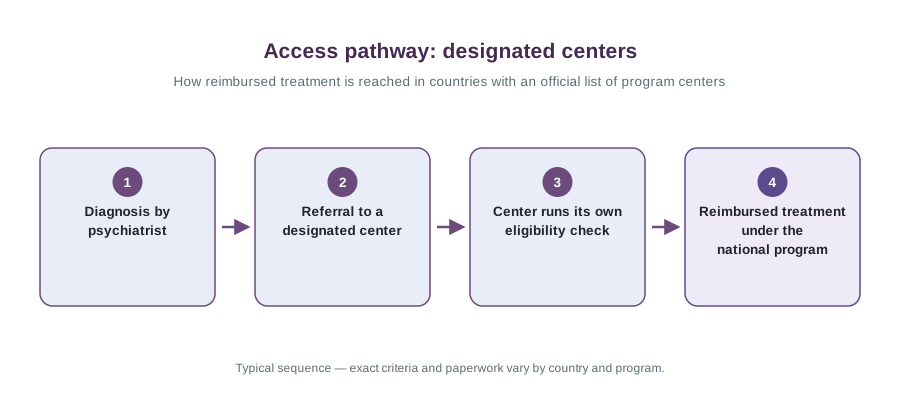
How to start. Your GP (huisarts) refers you into specialist GGZ care if you are not already there; a psychiatrist then confirms the diagnosis (unipolar, non-psychotic depression), documents the three failed steps, and refers you to an esketamine center — ideally one contracted by your insurer. The center confirms coverage before starting; patient organizations have documented friction between insurers and prescribers, so let the center manage the paperwork. The practical currency is a written treatment history — every antidepressant and augmentation strategy tried in the current episode, with dose, duration and outcome; gather old prescriptions, discharge letters and pharmacy records before the assessment rather than after it.
Cost and waiting. Treatment counts toward your annual deductible (eigen risico). Waiting lists at centers can run months — ask for the current estimate and discuss bridging options with your psychiatrist. Induction is typically twice weekly for four weeks; frequency then tapers based on measured response. For how the Dutch three-step requirement compares with the rest of the continent, see our Europe-wide reimbursement map.
Hospital (es)ketamine and the oral esketamine question
Several hospital psychiatric departments run (es)ketamine units for infusion-based treatment in specialist or research settings; access runs through psychiatric referral, and each unit applies its own protocol. Outside these settings, ketamine for depression is not part of regular reimbursed care, and the Netherlands has no private ketamine clinic market comparable to the UK or Spain.
The most-watched question here is oral esketamine. Generic oral esketamine is being studied under the Zorginstituut's "promising care" (veelbelovende zorg) scheme for severe, non-psychotic, treatment-resistant depression. The honest status in July 2026: a coverage decision was earlier expected around 2026, but the research project — which started on 1 September 2020 — now runs on a longer timeline, with results due to the Zorginstituut around 2029. Until then, oral esketamine does not meet the "state of science and practice" standard and is not reimbursed from the basic package outside the research itself. If a clinician offers you oral esketamine, ask explicitly whether it is inside the study protocol.
Psilocybin and MDMA: research participation only
Psilocybin and MDMA remain controlled under the Opiumwet with no medical-access or reimbursement route — the esketamine nasal spray is currently the only psychedelic-class medicine available on prescription in the Netherlands, as Blossom's country report confirms. What the Netherlands does have is one of Europe's densest research pipelines. Recruiting and active studies in 2026 include psilocybin research at Maastricht University and LUMC (among them a psilocybin study in fibromyalgia), the European PsyPal psilocybin trial for psychological distress in palliative care with UMCG as a site, and an MDMA-assisted psychotherapy trial for PTSD at ARQ Centrum'45 in Oegstgeest.
Momentum is real: the 2024 report of the Dutch State Commission on MDMA explored therapeutic use for PTSD and proposed a large naturalistic study, and government funding flows into psychedelic research via ZonMw. But none of this is an access route today — anyone offering psilocybin or MDMA therapy commercially in the Netherlands is operating outside the law. If trial participation interests you, our trials guide explains how to search and what participation involves.
Truffle retreats: legal, but not medical care
Psilocybin truffle retreats operate legally in the Netherlands because fresh truffles were never scheduled — but they are wellness businesses, not healthcare. They are not run under medical regulation, no medical screening obligations apply to them, their facilitators are usually not clinicians, no insurer covers them, and they cannot lawfully claim to treat depression or PTSD. For someone with significant psychiatric history, attending a retreat without independent medical advice carries real risk: screening standards vary enormously and there is no clinical follow-up if things go wrong. Retreats fall outside the scope of this directory; if you are considering one anyway, tell your treating clinician first — a retreat is not a substitute for the supervised routes described above.
Clinical trials in the Netherlands
The research route is strong here. Blossom tracks 54 psychedelic trials connected to the Netherlands, 12 of them active, across 21 organisations — with psilocybin, ketamine/esketamine and MDMA dominating the pipeline. Maastricht University is the historic hub, with active groups at UMCG, LUMC, UMC Utrecht, Leiden and ARQ Centrum'45. Participation is free and legal, but screening is strict, placebo arms are common, and enrolment is never guaranteed. See the trials guide for how phases, placebo and consent work, and search ClinicalTrials.gov for current Dutch listings.
What to expect in treatment
Whichever route you take, the shape of care is similar and worth picturing in advance. It begins with a screening appointment: the clinician reviews your psychiatric and medication history, checks your cardiovascular health and current medicines, and confirms the diagnosis before anything is scheduled. This is also where contraindications are caught.
On a Spravato day you self-administer the nasal spray under supervision at the center, then stay for an observation period — typically around two hours — while staff monitor blood pressure, heart rate and how you feel. A dreamlike, detached sensation and a temporary rise in blood pressure are expected effects that settle as the drug clears. You must not drive until the next day, so plan transport for every visit. Between sessions you continue the oral antidepressant, and centers measure your response with structured questionnaires; ongoing psychotherapy or integration support alongside the medicine is standard good practice.
In hospital (es)ketamine units, infusion-based treatment follows the same logic — screening, monitored dosing over about 40–60 minutes, a recovery period and follow-up — under each unit's own specialist or research protocol. In trials, add the study visits: baseline assessments, structured questionnaires and scheduled follow-up are part of the deal.
Risks and who should not start
Supervised (es)ketamine treatment is generally well tolerated, but it is not for everyone — which is exactly what the somatic screening at Dutch centers is designed to catch. Common, transient effects during or shortly after a session include dissociation, nausea, dizziness, mild perceptual changes, and a short-lived rise in blood pressure and heart rate; these resolve as the drug is metabolised. Treatment may be inappropriate, or require particular caution and specialist evaluation, when any of the following apply:
- Uncontrolled hypertension or significant cardiovascular instability, including a history of aneurysmal vascular disease, because of the temporary rise in blood pressure.
- A personal or family history of psychosis or bipolar disorder — the reimbursed indication is unipolar, non-psychotic depression, and this caution applies even more strongly to classic psychedelics such as psilocybin, whether in a trial or a truffle retreat.
- Pregnancy or breastfeeding.
- Substance-use concerns, particularly patterns of compulsive use.
A responsible provider screens for all of these before the first dose. If any setting is willing to treat you without that assessment, treat it as a warning sign. To see who is listed near you, browse providers in the Netherlands.
Frequently asked questions
Do I qualify for Spravato if I've only tried two antidepressants?
Not for reimbursed treatment — the Dutch framework requires the additional augmentation step. Your psychiatrist may complete an augmentation trial first, which is standard practice anyway.
Can I self-refer to an esketamine center?
No. Centers require a referral from a psychiatrist with a documented medication history. Starting with your GP (huisarts) is the practical first step.
Is oral or intravenous ketamine reimbursed?
Oral esketamine is only available within the Zorginstituut's "promising care" research, which runs to about 2029 — no reimbursement decision has been made as of July 2026. Hospital infusion units operate under specialist or research protocols; private ketamine offerings fall outside the basic package.
Is psilocybin or MDMA therapy available in the Netherlands?
Only inside clinical trials. Both substances remain controlled under the Opiumwet with no medical access route. Recruiting Dutch studies exist — psilocybin at Maastricht, LUMC and UMCG, MDMA for PTSD at ARQ Centrum'45 — and the trials guide explains how participation works.
Are truffle retreats a legal form of therapy?
They are legal as wellness services. They are not licensed medical treatment, not supervised by health regulators, carry no medical screening obligations, and are not appropriate for people with significant psychiatric conditions without independent medical advice.
How long is a session, and can I drive afterwards?
Budget most of a morning or afternoon: a short self-administration under supervision followed by an observation period, typically around two hours. You must not drive until the next day, so arrange a lift home for every visit.
Sources
- ENC-NL: Esketamine Neusspray Consortium Nederland
- NVvP criteria for specialized esketamine centers (PDF)
- Zorginstituut Nederland: Pakketadvies esketamine neusspray
- Zorginstituut Nederland: Veelbelovende zorg — orale esketamine bij ernstige depressie
- Blossom: Netherlands country report
- Psychedelic Alpha: Worldwide psychedelic laws tracker
- NTVG: Overweeg (es)ketamine bij therapieresistente depressie
- GGZ Nieuws: Geen vergoeding esketamine bij acute behandeling
- ClinicalTrials.gov: NCT06954025 — MDMA-assisted psychotherapy for PTSD (ARQ Centrum'45)
- ClinicalTrials.gov: NCT06368492 — psilocybin in fibromyalgia (Maastricht/LUMC)
- OPEN Foundation: Key insights from the Dutch State Commission MDMA report
- BIG register (verify practitioners)
This guide is for general information only and is not medical advice, a diagnosis, or a recommendation of any treatment. Regulations and reimbursement rules change; always verify current requirements with your insurer and discuss your options with a licensed clinician who knows your history. If you are in crisis, contact your local emergency number or a crisis line immediately.
This guide awaits review by a licensed medical professional.