If you are considering psychedelic-assisted treatment in Germany (for yourself or for someone close to you) four legal routes exist in July 2026: insurance-covered esketamine, a private ketamine clinic market, the EU's first psilocybin compassionate use program, and clinical trials. A fifth substance people often ask about, MDMA, has no route outside research. Which door is open to you depends almost entirely on your documented treatment history, so the most useful thing you can do before any appointment is write down every antidepressant you have tried in the current episode, with dose, duration and outcome; you can begin orienting yourself with our eligibility check.
TL;DR Spravato (esketamine nasal spray) is covered by statutory insurance (GKV) for treatment-resistant depression (no response to at least two antidepressants in the current moderate-to-severe episode), and since March 2023 it can be given in office-based psychiatric practices, where a nationwide Praxisbesonderheit agreement means prescribing it does not hurt your psychiatrist's budget. Private ketamine infusions cost roughly €200–400 per session, self-pay. Psilocybin is available only through the compassionate use program at ZI Mannheim and OVID Berlin: treatment-resistant depression only, roughly 50 patients in the first year, the drug free by law, and the program has been renewed, with the current BfArM listing running to 17 June 2027. MDMA therapy is research-only, with no German trial recruiting as of July 2026.
At a glance
| Route | Substance | Status in Germany | Who qualifies | Cost |
|---|---|---|---|---|
| Reimbursed esketamine | Esketamine (Spravato) | Licensed and GKV-reimbursed; running, including in office-based practices | Adults with severe treatment-resistant depression: no response to at least 2 antidepressants at adequate dose and duration in the current moderate-to-severe episode | Covered (standard co-payments only) |
| Private ketamine clinics | Ketamine (off-label) | Legal; self-pay market | Off-label decision after medical screening; broader than the Spravato label | €200–400 per infusion; a course of six typically €1,500–2,500 |
| Psilocybin compassionate use | Psilocybin | Running since 11 July 2025 at two sites; renewed: current BfArM listing to 17 June 2027 | Adults with treatment-resistant depression, in justified exceptional cases, when trial participation is not possible; the sites select patients | Drug free by law; care embedded in general psychiatric treatment, confirm costs with the site |
| MDMA therapy | MDMA | Research only; no trial currently recruiting | – | – |
| Clinical trials | Ketamine, esketamine, LSD, psilocybin, others | 23 trials tracked, 5 active; some recruiting | Study-specific criteria | Free |
Full coverage details: Is Spravato reimbursed in Germany?
Esketamine (Spravato): the route that works today
Esketamine nasal spray is approved, alongside an oral antidepressant, for adults with treatment-resistant major depression, defined as no response to at least two different antidepressants at adequate dose and duration in the current moderate-to-severe episode. GKV coverage tracks this label, and two decisions made the route unusually solid:
- In 2023 the G-BA found a "considerable added benefit" for esketamine in severe treatment-resistant depression, reportedly a first for a psychiatric drug in Germany (Deutsches Ärzteblatt).
- A nationwide Praxisbesonderheit agreement excludes Spravato prescriptions from the doctor's normal budget. If a psychiatrist says they "can't afford" to prescribe it, this agreement is the answer.
How to start: since March 2023, treatment is possible in office-based psychiatric practices, not only hospitals: you self-administer the spray under supervision and stay for observation, which practices bill through a dedicated code (GOP 01549). There is no formal insurer pre-authorization for on-label outpatient use: the practical hurdle is finding a practice or outpatient department that offers the treatment, since the observation requirement demands space and staff. A GP can refer you and print out your medication history; the prescribing decision sits with a psychiatrist.
Cost: for patients who meet the criteria, treatment is covered apart from standard co-payments. Paying privately instead is rare and expensive: the list price is around €345 per 28 mg device, so a four-week induction can reach roughly €8,000 before clinic fees.
Ketamine clinics: private care, fully self-pay
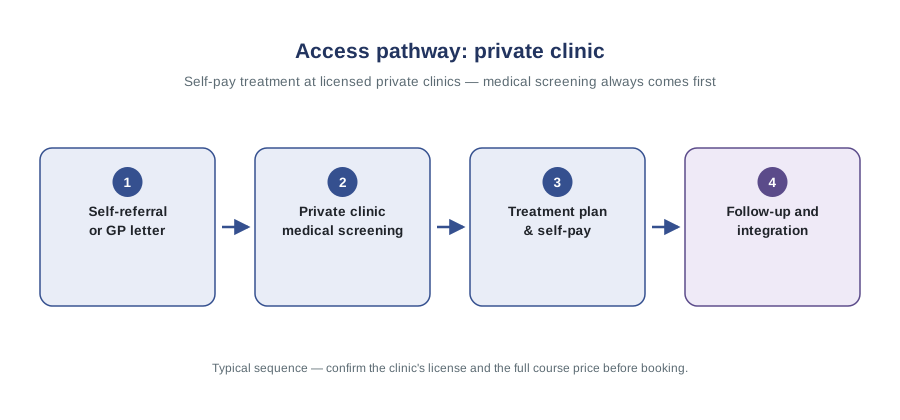
Racemic ketamine is a licensed anaesthetic, and physicians may prescribe it off-label for depression. This is the legal basis for Germany's private infusion and ketamine-assisted psychotherapy (KAP) clinics. Expect roughly €200–400 per infusion, with a typical course of six sessions over two to four weeks costing €1,500–2,500, entirely self-pay.
Two things are worth knowing before you spend money. First, Germany's national depression guideline takes a conservative line on off-label ketamine, placing it in inpatient psychiatric settings (Blossom's Germany report), so a careful outpatient provider should be selective about who they accept, not casual. Second, because this route is less regulated than the Spravato label, screening quality is the thing to check: a reputable clinic takes a psychiatric and cardiovascular history before taking your money, has a physician present during sessions, and measures outcomes. Our guide to choosing a clinic covers red flags in detail. And for how Germany's coverage picture compares with the rest of the continent, including the exceptional §2 Abs. 1a SGB V route to individual coverage; see our Europe-wide reimbursement map.
Psilocybin: the EU's first compassionate use program – small, real, time-limited
In July 2025 Germany became the first EU country to allow legal access to psilocybin before market approval, through a BfArM-confirmed compassionate use program. It runs at exactly two sites, the Central Institute of Mental Health (ZI/CIMH) in Mannheim and OVID Clinics in Berlin, under the same medical leadership, and is limited to adults with treatment-resistant depression in justified exceptional cases. This is a cohort notification procedure under the AMG/AMHV framework, not a prescription pathway or an approval (Blossom's Germany report). What that means in practice:
- The sites select patients. Psychiatrists at ZI Mannheim and OVID Berlin decide on admission: no patient-by-patient approval from a regulator is needed, which removes a bottleneck that slows similar programs elsewhere. You need documented failure of at least two adequate antidepressant treatments, and you must show that participation in a psilocybin trial is not possible for you.
- The drug is free by law. Under the program's terms the psilocybin (Filament Health's botanical candidate PEX010) must be provided to patients at no charge. Treatment is embedded in general psychiatric care at both facilities, which the program's lead expects to be covered by health insurance, though routine statutory reimbursement for the program is not formally established, so ask the site for the cost picture in writing.
- Capacity is small and a wait is likely. The group planned for roughly 50 patients in the first year, with dosing sessions monitored by two trained health professionals including a physician, and repeat dosing allowed under the protocol.
- The listing is time-limited but has been renewed. The initial one-year BfArM listing began on 11 July 2025 and has been renewed: the current listing runs to 17 June 2027 (BfArM compassionate use table). The program admits patients in justified exceptional cases; the BfArM table is the place to check the listing's current status.
If you fit the profile, ask your psychiatrist to contact one of the two sites directly, with your full treatment history attached. Anyone offering psilocybin sessions outside this program and clinical trials is operating illegally in Germany, whatever the marketing says.
MDMA: research only – and nothing recruiting right now
MDMA remains a controlled substance under Anlage I of the BtMG, with no medical-access or reimbursement route in Germany. The position in July 2026: German teams have completed MDMA-assisted psychotherapy feasibility work for PTSD, but no MDMA trial in Germany is listed as recruiting or active on ClinicalTrials.gov. If MDMA-assisted therapy matters to you, the realistic options are watching the registries for new German studies, or looking at Switzerland's limited medical use program (which requires being in Swiss care), and trial sites elsewhere in Europe; our trials guide explains how to search and what participation involves. Anyone offering MDMA therapy commercially in Germany today is operating illegally.
Clinical trials in Germany
The research route is active: Blossom currently tracks 23 psychedelic trials connected to Germany, five of them active (Blossom's Germany report). Recruiting now are Ket+CBASP, a Phase 2 study combining ketamine with structured psychotherapy for chronic depression, and INTENSIFY, a Phase 3 study of intensified pharmacological treatment after a first treatment failure. MindMed's Phase 3 study of MM120 (an LSD formulation) for generalised anxiety disorder includes German sites but is no longer recruiting. On the psilocybin side, the German landmark study EPIsoDE (ZI Mannheim and Charité Berlin) is completed and published, and no German psilocybin trial is recruiting as of July 2026: the compassionate use program above is partly built on that trial infrastructure. Participation is free and legal, but screening is strict and enrolment is never guaranteed. See the trials guide for how phases, placebo and consent work, and search ClinicalTrials.gov for current listings.
What to expect in treatment
Medically reviewed by Dr. Amy Reichelt, PhD, 31 July 2026: this section and the risks section below.
These routes share a shape (medical screening, supervised administration, structured follow-up), but they are not interchangeable: the indication, the schedule, the staffing and the strength of the evidence all differ depending on whether you are prescribed Spravato (esketamine), given ketamine, or entering a legal psychedelic-assisted therapy route, where your country has one. What every route has in common is where it starts. Treatment begins with a screening appointment: the clinician reviews your psychiatric and medication history, checks your cardiovascular health and current medicines, and confirms the diagnosis before anything is scheduled. This is also where contraindications are caught.
On a Spravato day you self-administer the nasal spray in the practice or clinic under supervision, then stay for an observation period of roughly two hours while staff monitor blood pressure, heart rate, sedation, dissociation, breathing and overall recovery. Dissociation, dizziness, sedation, nausea and a temporary rise in blood pressure are common (though they do not occur in everyone), and settle as the drug clears. You must not drive, operate machinery or undertake anything hazardous until the following day, after a night's sleep, so arrange transport home. Induction is typically more frequent at first and then tapers based on measured response. Under the European label, Spravato for treatment-resistant depression is taken alongside a continuing oral SSRI or SNRI antidepressant.
A ketamine infusion for depression is an off-label use of the drug. It is usually given intravenously over about 40 minutes, with vital-sign and psychological monitoring and a recovery period afterwards. Some services offer ketamine-assisted psychotherapy (KAP), which wraps the dosing in preparation and integration sessions with a therapist; others provide ketamine as a medical antidepressant treatment with no psychotherapy component at all, which is worth establishing before you book. Where a legal psychedelic-assisted therapy route exists, and what that route is depends on the country: a clinical trial in most, a regulated programme or compassionate-use scheme in a few; dosing days are long and closely supervised by trained clinical staff, and sit inside a broader plan of preparation, general psychiatric care and integration. In every setting the medicine is one part of the plan: screening, monitoring and follow-up reduce risk but cannot eliminate it, and psychotherapy or integration may help you make sense of what the treatment brings up and apply it afterwards.
Risks and who should not start
These treatments are generally well tolerated under supervision, but they are not for everyone, which is exactly what screening is for. Common, transient effects during or shortly after a session include dissociation (a detached, dreamlike feeling), nausea, mild perceptual changes, and a short-lived rise in blood pressure and heart rate; these resolve as the drug is metabolised. Treatment may be inappropriate, or require particular caution and specialist evaluation, when any of the following apply:
- Uncontrolled hypertension or significant cardiovascular instability, including a history of aneurysmal vascular disease. This is a contraindication for Spravato, because of the temporary rise in blood pressure; the other treatments carry their own cardiovascular assessment.
- A personal or family history of psychosis or bipolar disorder: a particular caution for classic psychedelics such as psilocybin, which legal programmes screen for carefully.
- Pregnancy or breastfeeding.
- Current uncontrolled substance use, a history of ketamine misuse, or a high risk of compulsive use: any of these may make treatment inappropriate or require specialist assessment.
A responsible provider screens for all of these before the first dose. Careful screening, monitoring and follow-up reduce risk; they do not remove it. If a clinic is willing to treat you without that assessment, treat it as a warning sign; see our clinic-choice guide. To see who is listed near you, browse providers in Germany.
Reviewer's note. Ketamine, Spravato (esketamine) and psilocybin-assisted therapies share common elements such as screening, supervision and follow-up, but they should not be presented as interchangeable. Each has distinct indications, contraindications, monitoring requirements and levels of evidence. Spravato follows a regulated treatment pathway, while IV ketamine is generally used off-label and psilocybin therapies remain largely investigational. Importantly, careful screening and clinical monitoring reduce risk but do not eliminate it.
— Dr. Amy Reichelt, PhD, neuroscientist, chartered psychologist and psychotherapist, PsyAccess medical reviewers
Frequently asked questions
Can my GP prescribe Spravato?
No. The prescribing decision is reserved for psychiatrists, and administration happens under medical supervision with a post-dose observation period. A GP can refer you and, very usefully, print out your medication history.
Is psilocybin therapy legal in Germany now?
Only inside the two-site compassionate use program and clinical trials. The program has been renewed (the current BfArM listing runs to 17 June 2027), and admits patients in justified exceptional cases through ZI Mannheim and OVID Berlin. Anyone offering psilocybin sessions outside those settings is operating illegally, whatever the marketing says.
How do I get into the psilocybin compassionate use program?
Through the two sites, not through a regulator: ask your psychiatrist to contact ZI Mannheim or OVID Berlin with documentation of at least two failed antidepressant treatments and evidence that trial participation is not possible for you. The sites decide on admission; capacity is around 50 patients per year, and a waiting list is to be expected.
Can I get MDMA therapy in Germany?
Not outside research, and as of July 2026 no MDMA trial in Germany is recruiting on ClinicalTrials.gov. Watch the registries, or look at trial sites elsewhere in Europe and Switzerland's limited medical use program, which requires being in Swiss care.
What if I don't meet the Spravato criteria?
Private ketamine clinics apply broader (off-label) criteria after their own screening, and trials each have their own inclusion rules. Discuss both with your psychiatrist before paying out of pocket.
How long is a session, and can I drive afterwards?
Most of a morning or afternoon, and you must not drive until the next day, after a restful sleep. Budget for a short administration plus a roughly two-hour observation for Spravato, or a 40–60 minute infusion plus recovery for ketamine; compassionate-use psilocybin dosing days run considerably longer. Plan a lift home.
Coming from another country? Whether a clinic will take a non-resident self-pay patient, what a Spravato induction schedule means for a visitor, and where cross-border treatment actually works: ketamine & psychedelic therapy in Europe for international patients.
Sources
- Gesundheitsinformation.de: Esketamin (Spravato) bei Depression
- G-BA Fachnews: Esketamin bei schwerer therapieresistenter Depression
- Deutsches Ärzteblatt: G-BA spricht Esketamin Zusatznutzen zu
- Der niedergelassene Arzt: Bundesweite Praxisbesonderheit für Esketamin-Nasenspray
- PPT: Esketamin-Nasenspray jetzt auch ambulant anwendbar
- KV Berlin: Zusatzpauschale GOP 01549
- Psychedelic Alpha: Germany establishes EU's first psilocybin compassionate access program
- Blossom: Germany country report
- Blossom: Medical access in Germany
- BfArM: Compassionate use programs table (psilocybin entry, current listing to 17.06.2027)
- Thieme: Spravato price discussion
- ClinicalTrials.gov: MDMA studies in Germany (no recruiting trials as of July 2026)
This guide is for general information only and is not medical advice, a diagnosis, or a recommendation of any treatment. Regulations and reimbursement rules change (the psilocybin program in particular is time-limited), so always verify current requirements with your insurer, the treatment sites, and a licensed clinician who knows your history. If you are in crisis, contact your local emergency number or a crisis line immediately.
This guide awaits review by a licensed medical professional.