If you are considering psychedelic-assisted treatment in Denmark (for yourself or for someone close to you), the picture in July 2026 is a public-system story with a research scene attached. Denmark has no private ketamine-clinic market to speak of and no legal access to psilocybin or MDMA outside trials; what it has is a brand-new recommendation that brings esketamine into routine specialist care for a narrow group, an acute-care route for the most severe crises, and Copenhagen hospitals recruiting for real psilocybin studies. This guide covers who qualifies for each route, how to start, what it costs, and what to realistically expect; you can begin orienting yourself with our eligibility check.
TL;DR In November 2025, Medicinrådet, the Danish Medicines Council, recommended Spravato (esketamine) for adults with moderate-to-severe treatment-resistant depression after at least three failed antidepressant treatments in the current episode, reversing its 2020 rejection after new long-term data and a price cut. Delivery runs through regional hospital psychiatry, and the expected volume is small: roughly 40–60 patients per year. Esketamine has also been recommended since January 2023 as acute short-term treatment for admitted patients with acutely increased suicide risk. Psilocybin and MDMA are research-only (recruiting studies exist at Rigshospitalet and Bispebjerg), and no association or private provider can legally administer them.
At a glance
| Route | Substance | Status in Denmark | Who qualifies | Cost |
|---|---|---|---|---|
| Esketamine for treatment-resistant depression | Esketamine (Spravato) | Recommended by Medicinrådet November 2025; regional rollout from a low base | Adults with moderate-to-severe depression after at least 3 failed antidepressant treatments in the current episode | Covered within public hospital psychiatry |
| Esketamine in acute crisis | Esketamine (Spravato) | Recommended since January 2023 | Admitted patients with depression and acutely increased suicide risk, where ECT is not tolerated, effective or wanted | Covered within hospital care |
| Psychedelic psychotherapy offers | Psilocybin, MDMA | The substances cannot legally be administered outside authorised research | – | – |
| Psilocybin / LSD / MDMA | Psilocybin, LSD, MDMA | Research only; psilocybin studies recruiting in Copenhagen | Study-specific criteria | Free in trials |
| Clinical trials | Psilocybin, LSD, esketamine, ketamine | 12 Denmark-linked trials tracked, 7 active | Study-specific criteria | Free |
Full coverage details: Is Spravato reimbursed in Denmark? · How the four Nordic systems compare: Esketamine and ketamine therapy in Scandinavia
Esketamine (Spravato): recommended in November 2025, rolling out from a low base
On 19 November 2025, Medicinrådet recommended esketamine nasal spray for adults with moderate-to-severe treatment-resistant depression that has not responded to at least three different antidepressant treatments in the current episode (Medicinrådet). Two things changed since the council's cautious 2020 assessment, when only four-week data existed: the manufacturer produced new studies evaluating effect over 32 weeks, showing with greater certainty that esketamine helps more patients achieve lasting improvement than current treatment, and it lowered the price.
Know what the recommendation is and is not. It makes esketamine a possible standard treatment that the five Danish regions deliver through hospital psychiatry, with supervised administration and observation; it does not create a network of clinics or a prescription you collect at a pharmacy. And the scale is deliberately modest: Medicinrådet estimates that roughly 40–60 patients per year may be candidates. Denmark is starting this route from a low base, so expect capacity to build gradually and unevenly across regions.
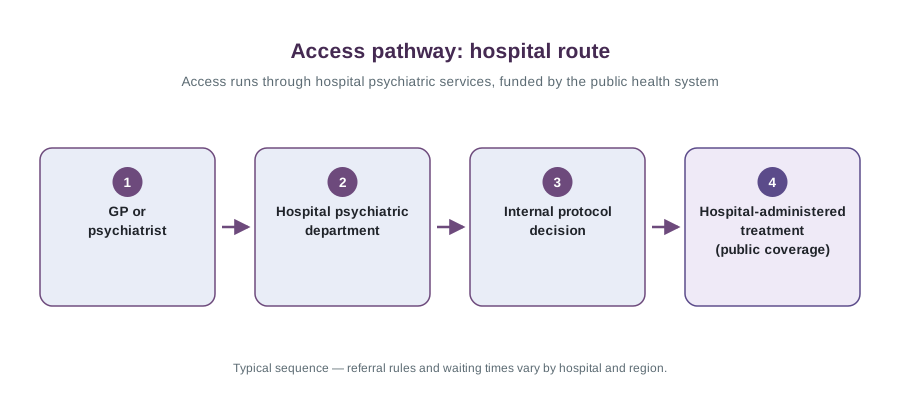
How to start: the route runs through your GP (egen læge) to regional psychiatry, or through the psychiatrist already treating you. The practical currency is a written treatment history: at least three antidepressant treatments in the current episode, each documented with substance, dose, duration and outcome. Three documented failures is a higher bar than most countries' two, and assembling proof is often the slower part of the process. Treatment itself is covered within public hospital psychiatry; for how Denmark compares with its neighbours, see our Europe-wide reimbursement map.
Esketamine in acute crisis: the route that already existed
Since January 2023, Medicinrådet has recommended esketamine, together with an oral antidepressant, as acute short-term treatment for rapid reduction of depressive symptoms in adults admitted with depression and acutely increased suicide risk (Medicinrådet). The council was explicit about the limits: it should be used only for patients who do not tolerate, do not benefit from, or after thorough information do not want electroconvulsive therapy, and there is no documented effect on suicide risk or suicidal behaviour itself; the documented effect is faster symptom reduction in some patients. This is an inpatient decision made by the treating hospital team during an admission, not a route anyone books; if it is relevant to you or a relative right now, the door is the psychiatric emergency system, not a waiting list.
Psilocybin and MDMA offers: what is legal in Denmark, honestly
Psilocybin, MDMA, DMT, mescaline and ketamine are List B controlled substances in Denmark (LSD is List A), usable only for medical and scientific purposes under Danish Medicines Agency rules; none of them is authorised as a psychiatric medicine, so no clinic, therapist or association can legally administer psilocybin or MDMA in Denmark outside an authorised trial (Danish Medicines Agency).
This matters because Danish patients searching for options will encounter offers of psychedelic psychotherapy: associations and therapists describing longer-term therapeutic courses involving psychedelic substances, often without published prices. The legal position is plain: what an association or therapist can lawfully provide in Denmark is psychotherapy (screening, preparation, integration, therapeutic support), and knowledge. They cannot legally supply or administer psilocybin or MDMA. If any offer, from any provider, includes an actual psilocybin or MDMA session in Denmark outside an authorised trial, that part has no legal basis, and you should ask direct questions about the legal and medical arrangement before going further. To see what is listed, browse providers in Denmark.
Psilocybin, LSD and MDMA research: Copenhagen's strong hand
Denmark's research scene is concentrated in Copenhagen and is unusually strong for the country's size: Blossom tracks 12 Denmark-linked trials, 7 of them active, with psilocybin the most-studied compound (Blossom: Denmark country report). Where the studies stand in July 2026:
- Recruiting now: PsyPal, the EU-funded Phase 2 trial of psilocybin therapy for psychological distress in palliative care, at Bispebjerg Hospital (NCT06782724); and a Phase 1 psilocybin study of serotonin-receptor effects at Rigshospitalet's Neurobiology Research Unit (NCT03289949).
- Reading out: the Copenhagen psilocybin programme for alcohol use disorder, an open-label study published in 2025 and the randomised Quantum Trip Trial, with follow-up completing in 2026.
- Also active: an LSD receptor-occupancy imaging study at Rigshospitalet (no longer enrolling), Danish participation in the Phase 3 COMP360 psilocybin programme for treatment-resistant depression (no longer enrolling), and a small published psilocybin study in chronic cluster headache.
- MDMA: no Danish MDMA trial is recruiting as of July 2026, a ClinicalTrials.gov search for MDMA studies with Danish sites returns none.
Participation is free and legal, but screening is strict and enrolment is never guaranteed. If a recruiting study fits your situation, ask your GP or psychiatrist about a referral to the study team.
Clinical trials in Denmark
The trial route deserves its own practical note, because in Denmark it is the only legal way to receive a classical psychedelic at all. Recruiting psilocybin studies in July 2026 are at Bispebjerg Hospital (palliative-care distress, PsyPal) and Rigshospitalet (Phase 1); a Phase 4 ketamine study in severe acute brain injury is also recruiting, though that is intensive-care medicine rather than psychiatry. Screening typically involves psychiatric and physical assessment over several visits, structured rating scales, and possible randomisation to a comparator. See the trials guide for how phases, placebo and consent work, and search ClinicalTrials.gov for current Danish listings, registries change faster than any guide.
What to expect in treatment
Medically reviewed by Dr. Amy Reichelt, PhD, 31 July 2026: this section and the risks section below.
These routes share a shape (medical screening, supervised administration, structured follow-up), but they are not interchangeable: the indication, the schedule, the staffing and the strength of the evidence all differ depending on whether you are prescribed Spravato (esketamine), given ketamine, or entering a legal psychedelic-assisted therapy route, where your country has one. What every route has in common is where it starts. Treatment begins with a screening appointment: the clinician reviews your psychiatric and medication history, checks your cardiovascular health and current medicines, and confirms the diagnosis before anything is scheduled. This is also where contraindications are caught.
On a Spravato day you self-administer the nasal spray in the practice or clinic under supervision, then stay for an observation period of roughly two hours while staff monitor blood pressure, heart rate, sedation, dissociation, breathing and overall recovery. Dissociation, dizziness, sedation, nausea and a temporary rise in blood pressure are common (though they do not occur in everyone), and settle as the drug clears. You must not drive, operate machinery or undertake anything hazardous until the following day, after a night's sleep, so arrange transport home. Induction is typically more frequent at first and then tapers based on measured response. Under the European label, Spravato for treatment-resistant depression is taken alongside a continuing oral SSRI or SNRI antidepressant.
A ketamine infusion for depression is an off-label use of the drug. It is usually given intravenously over about 40 minutes, with vital-sign and psychological monitoring and a recovery period afterwards. Some services offer ketamine-assisted psychotherapy (KAP), which wraps the dosing in preparation and integration sessions with a therapist; others provide ketamine as a medical antidepressant treatment with no psychotherapy component at all, which is worth establishing before you book. Where a legal psychedelic-assisted therapy route exists, and what that route is depends on the country: a clinical trial in most, a regulated programme or compassionate-use scheme in a few; dosing days are long and closely supervised by trained clinical staff, and sit inside a broader plan of preparation, general psychiatric care and integration. In every setting the medicine is one part of the plan: screening, monitoring and follow-up reduce risk but cannot eliminate it, and psychotherapy or integration may help you make sense of what the treatment brings up and apply it afterwards.
Risks and who should not start
These treatments are generally well tolerated under supervision, but they are not for everyone, which is exactly what screening is for. Common, transient effects during or shortly after a session include dissociation (a detached, dreamlike feeling), nausea, mild perceptual changes, and a short-lived rise in blood pressure and heart rate; these resolve as the drug is metabolised. Treatment may be inappropriate, or require particular caution and specialist evaluation, when any of the following apply:
- Uncontrolled hypertension or significant cardiovascular instability, including a history of aneurysmal vascular disease. This is a contraindication for Spravato, because of the temporary rise in blood pressure; the other treatments carry their own cardiovascular assessment.
- A personal or family history of psychosis or bipolar disorder: a particular caution for classic psychedelics such as psilocybin, which legal programmes screen for carefully.
- Pregnancy or breastfeeding.
- Current uncontrolled substance use, a history of ketamine misuse, or a high risk of compulsive use: any of these may make treatment inappropriate or require specialist assessment.
A responsible provider screens for all of these before the first dose. Careful screening, monitoring and follow-up reduce risk; they do not remove it. If a clinic is willing to treat you without that assessment, treat it as a warning sign; see our clinic-choice guide. To see who is listed near you, browse providers in Denmark.
Reviewer's note. Ketamine, Spravato (esketamine) and psilocybin-assisted therapies share common elements such as screening, supervision and follow-up, but they should not be presented as interchangeable. Each has distinct indications, contraindications, monitoring requirements and levels of evidence. Spravato follows a regulated treatment pathway, while IV ketamine is generally used off-label and psilocybin therapies remain largely investigational. Importantly, careful screening and clinical monitoring reduce risk but do not eliminate it.
— Dr. Amy Reichelt, PhD, neuroscientist, chartered psychologist and psychotherapist, PsyAccess medical reviewers
Frequently asked questions
Is esketamine available in Denmark right now?
Yes, on two tracks: since November 2025 as a recommended treatment for moderate-to-severe treatment-resistant depression after at least three failed antidepressant treatments, delivered through regional hospital psychiatry; and since January 2023 as acute short-term treatment for admitted patients with acutely increased suicide risk. Both run through hospital teams, not private clinics.
Why did Denmark say no in 2020 and yes in 2025?
In 2020 only four-week data existed, leaving real uncertainty about effect and side effects. By late 2025 the manufacturer had produced 32-week studies showing more patients achieving lasting improvement, and lowered the price. Medicinrådet's recommendation followed the new evidence and the new economics.
How quickly can I actually get it?
Modestly and unevenly: Medicinrådet estimates roughly 40–60 candidate patients per year nationwide, and the regions are building delivery from a low base. Expect the referral, the documentation of three failed treatments, and regional capacity to set your timeline, plausibly months.
Can an association or a private therapist give me psilocybin or MDMA therapy?
No one can legally administer psilocybin or MDMA in Denmark outside an authorised trial. An association or therapist can legally offer psychotherapy, preparation and integration work, but any offer that includes an actual substance session in Denmark has no legal basis.
How do I join a Danish psilocybin trial?
Two studies are recruiting in July 2026: PsyPal at Bispebjerg Hospital for psychological distress in palliative care, and a Phase 1 psilocybin study at Rigshospitalet's Neurobiology Research Unit. Read the registry entry criteria, then ask your GP or psychiatrist about a referral to the study team.
Can I get MDMA therapy in Denmark?
Not outside research, and no Danish MDMA trial is recruiting as of July 2026. Watch the registries or consider trial sites elsewhere in Europe: our trials guide explains how.
Coming from another country? Whether a clinic will take a non-resident self-pay patient, what a Spravato induction schedule means for a visitor, and where cross-border treatment actually works: ketamine & psychedelic therapy in Europe for international patients.
Sources
- Medicinrådet: Efter nye data og lavere pris — nu anbefaler Medicinrådet esketamin til svær behandlingsresistent depression (November 2025)
- Medicinrådet: Esketamin (Spravato) — moderat til svær depression hos voksne med akut øget selvmordsrisiko (recommendation, January 2023)
- Blossom: Denmark country report
- Blossom: Medical access in Denmark
- Psychedelic Alpha: Worldwide psychedelic laws tracker
- Danish Medicines Agency: Lists of euphoriant substances
- EMA: Spravato (esketamine) EPAR
- ClinicalTrials.gov: NCT06782724 — PsyPal, psilocybin therapy for psychological distress in palliative patients (recruiting; Bispebjerg Hospital site)
- ClinicalTrials.gov: NCT03289949 — psilocybin and 5-HT2A receptor modulation, Rigshospitalet Neurobiology Research Unit (recruiting)
- ClinicalTrials.gov: NCT05416229 — Quantum Trip Trial, psilocybin-assisted therapy for alcohol use disorder, Copenhagen
This guide is for general information only and is not medical advice, a diagnosis, or a recommendation of any treatment. Recommendations and delivery capacity are changing as Denmark's rollout begins; always verify current requirements with your region's psychiatric service or a licensed clinician who knows your history. If you are in crisis, contact emergency services on 112 or Livslinien on 70 201 201 immediately.
This guide awaits review by a licensed medical professional.