If you are considering psychedelic-assisted treatment in Czechia — for yourself or for someone close to you — four legal routes exist in July 2026, and they differ sharply in how real they are today. One is reimbursed and running, one is private with partial insurance coverage, one is legal on paper but not yet bookable, and one is limited to research. This guide covers who qualifies for each, how to start, what it costs, and what to realistically expect; you can begin orienting yourself with our eligibility check.
TL;DR Spravato (esketamine) has been reimbursed since February 2025 for adults under 65 with treatment-resistant depression — it is the one route you can start this month, through a psychiatrist. Ketamine-assisted psychotherapy at Prague's Psyon clinic is legal and partially covered by seven Czech insurers. Medical psilocybin became legal on 1 January 2026, but NUDZ confirmed in March 2026 that treatment has not started, no waiting list is open, and launch is expected in the second half of 2026. MDMA therapy is not available outside research, and no Czech MDMA trial is currently recruiting.
At a glance
| Route | Substance | Status in Czechia | Who qualifies | Cost |
|---|---|---|---|---|
| Reimbursed esketamine | Esketamine (Spravato) | Reimbursed since February 2025; running | Adults under 65 with non-psychotic treatment-resistant depression after at least two failed antidepressants | Covered by public insurance |
| Ketamine-assisted psychotherapy | Ketamine (off-label) | Legal; offered at Psyon in Prague | Clinic screening: depression, anxiety disorders, PTSD, eating disorders; 18+ with at least one prior treatment attempt | Partial coverage from seven insurers; meaningful self-pay share |
| Medical psilocybin | Psilocybin | Legal since 1 January 2026; treatment not yet started | Serious depression after authorised medicines failed or were not tolerated — once delivery begins | Reimbursement rules still being finalised |
| MDMA therapy | MDMA | Research only; no trial currently recruiting | — | — |
| Clinical trials | Psilocybin, LSD, ketamine, others | Several active studies, some recruiting | Study-specific criteria | Free |
Esketamine (Spravato): the route that works today
Since February 2025, esketamine nasal spray is reimbursed by Czech health insurers for adults under 65 with treatment-resistant depression: a moderate-to-severe episode, without psychotic symptoms, that has not responded to at least two antidepressants taken at adequate dose and duration. Reimbursement conditions run through the state drug agency SÚKL (sukl.cz).
How to start. The route runs through a psychiatrist — your GP can refer you, or you can approach psychiatric care directly. Administration and post-dose observation happen at equipped psychiatric facilities; Prague's Bohnice hospital, for example, operates a dedicated esketamine centre. The practical currency is a written treatment history: drugs, doses, durations, outcomes. Bring it to the first appointment — it does more work than anything you say in the room.
Cost and waiting. For patients who meet the criteria, treatment is covered. Waiting depends mostly on appointment availability at an equipped centre and on how quickly your documentation comes together — assembling proof of two adequate failed treatments is often the slower part. One nuance worth knowing: insurers can grant exceptional individual reimbursement beyond the standard criteria — for example for patients over 65 — when all other options are exhausted, so an age cut-off is not always the end of the road.
Ketamine-assisted psychotherapy: private care, partly insured
Prague's Psyon clinic — founded by clinicians connected to the Czech psychedelic research scene — offers structured ketamine-assisted psychotherapy: psychiatric and physical screening, preparation, supervised administration and integration. Ketamine is used off-label here, which is legal and standard practice, but it means the clinic requires at least one previous treatment attempt for your current episode.
Who qualifies. Psyon's published indications are depressive syndrome (including treatment-resistant depression), anxiety disorders (including OCD and social phobia), PTSD, and eating disorders. Admission requires being 18 or older and is always decided by a physician after a full psychiatric and physical assessment.
Cost and coverage. Psyon holds contracts with seven Czech insurers — VZP, VoZP, ČPZP, ZP MV ČR, OZP, RBP and ZP Škoda. For their clients, most outpatient psychiatric care and psychotherapy is covered, and the ketamine-assisted component is covered partially; a meaningful self-pay share remains, and a clinic subsidy program exists for those who cannot afford standard prices. As far as we know, Czechia is the only European country where ketamine-assisted psychotherapy gets partial insurer coverage at all — elsewhere it is purely self-pay. Ask the clinic for a written cost breakdown for your insurer before starting, and compare arrangements across the continent in our Europe-wide reimbursement map.
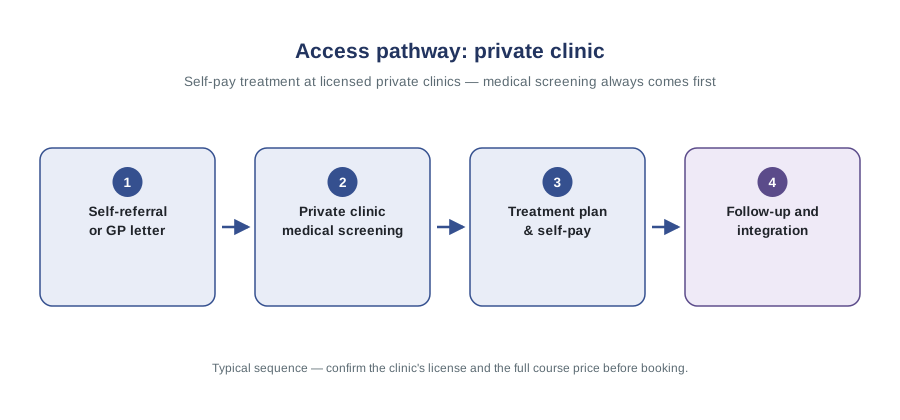
How to start and how long it takes. You can self-refer — contact the clinic for an initial meeting, after which the assessments are scheduled. Expect the screening itself to take several appointments before any treatment decision; that is a feature, not a delay.
Psilocybin: legal since January 2026 — but you cannot book it yet
Czechia became the first EU country with a full legal framework for medical psilocybin when a 2025 amendment to the Criminal Code took effect on 1 January 2026. The framework is narrow by design: psilocybin may be prescribed and administered only in specialised healthcare facilities, by qualified physicians, for defined serious mental-health conditions — severe depression, including depression associated with cancer — after authorised medicines have failed or were not tolerated.
The honest status in July 2026: the framework is live, treatment delivery is not. The National Institute of Mental Health (NUDZ) stated on 23 March 2026 that it is not yet possible to apply for psilocybin treatment or to register for a waiting list, because reimbursement conditions and funding rules are still being finalised. NUDZ expects the launch of treatment in the second half of 2026. What this means for you:
- You cannot currently book legal psilocybin therapy in Czechia, and anyone selling it today is operating outside the framework;
- No waiting list exists — any position or wait time someone quotes you today is not real;
- When delivery starts, expect a small number of authorised sites, strict criteria and genuine waiting lists — a controlled rollout, not an open market;
- If your situation fits the target profile, ask your psychiatrist to watch NUDZ announcements; meanwhile, the Spravato route may already be open to you, and trials are a live option.
MDMA: research participation only
MDMA remains a controlled psychotropic substance in Czechia with no medical-access or reimbursement route. The country does have real MDMA research history: NUDZ was a site in an international Phase 2 trial of MDMA-assisted psychotherapy for PTSD (NCT04030169), which is now completed. As of July 2026, no MDMA trial in Czechia is listed as recruiting on ClinicalTrials.gov, and a planned long-term follow-up study was withdrawn.
If MDMA-assisted therapy matters to you, the realistic options are watching the registries for new Czech studies or considering trial sites elsewhere in Europe — our trials guide explains how to search and what participation involves. Anyone offering MDMA therapy commercially in Czechia today is operating illegally.
Clinical trials in Czechia
The research route is unusually strong here. NUDZ in Klecany anchors the system and has run psilocybin and ketamine studies for years; Blossom currently tracks about twenty trials connected to Czechia, six of them active. Recruiting studies include PsyPal, a European psilocybin trial for psychological distress in palliative care, and Czech sites also appear in international Phase 3 programs for psilocybin and LSD; Psyon serves as a trial site too. Participation is free and legal, but screening is strict and enrolment is never guaranteed. See the trials guide for how phases, placebo and consent work, browse trial sites in Czechia, and search ClinicalTrials.gov for current listings.
What to expect in treatment
Whichever route you take, the shape of care is similar and worth picturing in advance. It begins with a screening appointment: the clinician reviews your psychiatric and medication history, checks your cardiovascular health and current medicines, and confirms the diagnosis before anything is scheduled. This is also where contraindications are caught.
On a Spravato day you self-administer the nasal spray at the psychiatric facility under supervision, then stay for an observation period of roughly two hours while staff monitor blood pressure, heart rate and how you feel; a detached, dreamlike sensation and a temporary rise in blood pressure are expected effects that settle as the drug clears. You must not drive for the rest of the day, so arrange a ride home. Induction sessions are typically more frequent at first and then taper based on measured response, alongside a continuing oral antidepressant.
A ketamine session in a KAP program is usually built around an infusion given intravenously over about 40–60 minutes, with the same vital-sign monitoring and a recovery period afterwards, wrapped in preparation and integration sessions with a therapist — the structure Psyon uses. In every setting the medicine is one part of the plan: screening, monitoring and follow-up are what make it safe, and psychotherapy or integration is what helps the effect last.
Risks and who should not start
These treatments are generally well tolerated under supervision, but they are not for everyone, which is exactly what screening is for. Common, transient effects during or shortly after a session include dissociation, nausea, mild perceptual changes and a short-lived rise in blood pressure and heart rate; these resolve as the drug is metabolised. Treatment may be inappropriate, or require particular caution and specialist evaluation, when any of the following apply:
- Uncontrolled hypertension or significant cardiovascular instability, including a history of aneurysmal vascular disease, because of the temporary rise in blood pressure.
- A personal or family history of psychosis or bipolar disorder — a particular caution for classic psychedelics such as psilocybin, which the Czech framework and existing trials screen for carefully.
- Severe liver disease or other serious somatic illness, which Psyon's published criteria list among the medical contraindications for ketamine.
- Pregnancy or breastfeeding.
- Substance-use concerns, particularly patterns of compulsive use; clinics also screen for acute suicidality risk and severe personality disorders before admission.
A responsible provider screens for all of these before the first session. If a clinic is willing to treat you without that assessment, treat it as a warning sign. To see who is listed near you, browse providers in Czechia.
Frequently asked questions
Is psilocybin therapy available in Czechia right now?
No. The legal framework took effect on 1 January 2026, but NUDZ stated on 23 March 2026 that it is not yet possible to apply for treatment or register for a waiting list. Launch is expected in the second half of 2026 — follow NUDZ's official statements rather than commercial promises.
Can I get MDMA therapy in Czechia?
Not outside research. MDMA remains a controlled substance with no medical route. NUDZ took part in a now-completed Phase 2 PTSD trial, and no Czech MDMA study is recruiting as of July 2026. Watch the registries or consider trial sites elsewhere in Europe.
Is Spravato coverage automatic if I have treatment-resistant depression?
Coverage follows the reimbursement conditions — age under 65, no psychotic symptoms, and documented failure of at least two adequate antidepressant trials — and requires a psychiatrist at an equipped facility. Your documentation does most of the work, and exceptional individual reimbursement is sometimes possible outside the standard criteria.
How much of Psyon's ketamine-assisted therapy do insurers pay?
It depends on your insurer and the component of care. Clients of Psyon's seven contracted insurers get most outpatient psychiatry and psychotherapy covered, while the ketamine-assisted component is covered partially, with a meaningful self-pay share. Ask for a written cost breakdown for your insurer before starting; a subsidy program exists for those who cannot afford standard prices.
Is Czechia a destination for treatment from abroad?
For trials, sometimes. Reimbursed Spravato and insurer-covered KAP are tied to Czech public insurance, and the psilocybin framework is being built for the Czech healthcare system, not for treatment tourism.
How long will I wait for each route?
Spravato: mostly the time it takes to get a psychiatric appointment and assemble your treatment history. KAP at Psyon: the clinic's intake and multi-appointment screening. Psilocybin: unknowable today — no list exists to join. Trials: screening typically takes weeks, with no guarantee of enrolment.
Sources
- NUDZ: Official statement on the availability of psilocybin treatment (23 March 2026)
- Blossom: Czechia country report
- Blossom: Medical access in Czechia
- Psychedelic Alpha: Worldwide psychedelic laws tracker
- SÚKL — State Institute for Drug Control
- Psyon — psychedelic clinic, Prague: services, insurers and admission criteria
- EMA: Spravato (esketamine) EPAR
- ClinicalTrials.gov: NCT04030169 — MDMA-assisted psychotherapy for PTSD (completed; NUDZ site)
- EU TRIS: Czech implementing regulation on therapeutic psilocybin
- Expats.cz: Czechia to legalize medical use of psilocybin from 2026
This guide is for general information only and is not medical advice, a diagnosis, or a recommendation of any treatment. Regulations and reimbursement rules change quickly in Czechia's rollout phase; always verify current requirements with SÚKL, your insurer, or a licensed clinician who knows your history. If you are in crisis, contact your local emergency number or a crisis line immediately.
This guide awaits review by a licensed medical professional.