If you are considering psychedelic-assisted treatment in Austria (for yourself or for someone close to you), the picture in July 2026 is defined less by what is legal than by who pays. Esketamine is authorized and genuinely available, but public funding runs through hospital stays and case-by-case approvals rather than a routine outpatient entitlement, which is why Vienna has grown a private market of specialist practices. Psilocybin and MDMA remain research-only. This guide covers who qualifies for each route, how to start, what it costs, and what to realistically expect; you can begin orienting yourself with our eligibility check.
TL;DR Spravato (esketamine) is authorized EU-wide and used in Austria for treatment-resistant depression, but it is not part of the routine outpatient reimbursement list: as an inpatient, treatment is covered through hospital financing (LKF); as an outpatient, coverage depends on a case-by-case chefärztliche Bewilligung from your sickness fund, and many patients end up paying privately. Vienna's private practices (Dr. Buchmayer, PsyTherapie) publish fee schedules, and the Wahlarzt system refunds part of the cost. Psilocybin and MDMA are research-only under the Suchtmittelgesetz; the Medical University of Vienna is recruiting for a psilocybin study in depression with anhedonia, and no Austrian MDMA trial is recruiting as of July 2026.
At a glance
| Route | Substance | Status in Austria | Who qualifies | Cost |
|---|---|---|---|---|
| Hospital esketamine | Esketamine (Spravato) | Authorized; funded within inpatient care via LKF hospital financing | Treatment-resistant depression, assessed by the hospital psychiatric team | Covered as part of the hospital stay |
| Outpatient esketamine | Esketamine (Spravato) | Case-by-case sickness-fund approval (chefärztliche Bewilligung); otherwise self-pay | Treatment-resistant depression with documented failed treatments | Covered only if approved; many pay privately |
| Private esketamine practices | Esketamine / ketamine (off-label) | Legal; Vienna market with published fees | Practice screening, typically depression including treatment-resistant depression | Self-pay with partial Wahlarzt refunds |
| Psilocybin therapy | Psilocybin | Research only (Suchtmittelgesetz); one recruiting study in Vienna | Study-specific criteria | Free within the trial |
| MDMA therapy | MDMA | Research only; no trial recruiting | – | – |
| Clinical trials | Psilocybin, ketamine, esketamine | 14 tracked, 5 active | Study-specific criteria | Free |
Full coverage details: Is Spravato reimbursed in Austria?
Esketamine (Spravato): authorized, but the funding runs through the hospital
Spravato is EMA-authorized for treatment-resistant depression (adults whose current moderate-to-severe episode has not responded to at least two antidepressants) taken together with an SSRI or SNRI, and administered under direct clinical supervision with post-dose observation. What Austria has not done is place it in the routine outpatient reimbursement code, so funding works in one of two ways:
- Inpatient: if you are treated on a psychiatric ward, esketamine is funded like the rest of your care through the hospital financing system (LKF). The hospital's own psychiatric team is the gatekeeper: it assesses your treatment history and decides whether esketamine belongs in your plan. The treatment-resistant depression outpatient service at AKH Wien, the university hospital of the Medical University of Vienna, is the best-known specialist port of call: its clinicians run one of Europe's most active research groups on fast-acting antidepressants (MedUni Wien).
- Outpatient: outside hospital walls, whether your sickness fund pays is decided case by case by the fund's chief physician (chefärztliche Bewilligung). Your psychiatrist submits the request; the file that decides it is your documented treatment history: substance, dose, duration and outcome for every antidepressant tried in the current episode. Approvals are real but not guaranteed, which is why many Austrian patients end up paying privately.
How to start: ask your GP or psychiatrist for a referral to a hospital psychiatric service (in Vienna, the AKH treatment-resistant depression service) or have your psychiatrist file the chief-physician request directly. Either way, assemble the written treatment history first; it does more work than anything you say in the room. For how Austria's arrangement compares with its neighbours, see our Europe-wide reimbursement map.
Private practices: the Vienna market
Austria's Wahlarzt system (private physicians whose invoices the sickness funds partly refund) has produced a small but genuine private market for esketamine treatment, concentrated in Vienna. Two practices publish their programs and fees, and both appear in our directory for Austria:
- Ordination Dr. Buchmayer (LEBEN PSYCHE Zentrum, 1090 Vienna) focuses on depression and treatment-resistant depression, offering esketamine as both Spravato nasal spray and infusion in the practice, alongside TMS, tDCS, pharmacogenetics and psychotherapy. Treatment follows a structured course: an induction phase of about eight sessions over four weeks with a formal evaluation, then a maintenance phase over several months. Per the practice's published fee overview, a first consultation is EUR 400 and an esketamine session EUR 150–250, with the two-hour supervised session format required for this medicine.
- PsyTherapie — Dr. Platz (Vienna and Klagenfurt) offers esketamine-based treatment for treatment-resistant depression, OCD, PTSD and chronic suicidal distress, with the option of combining the supervised session with integrated psychotherapy. Published fees are EUR 350 for a treatment session and EUR 450 with psychotherapy; as a Wahlarzt practice of all public insurers, a typical refund of EUR 80–110 per session applies.
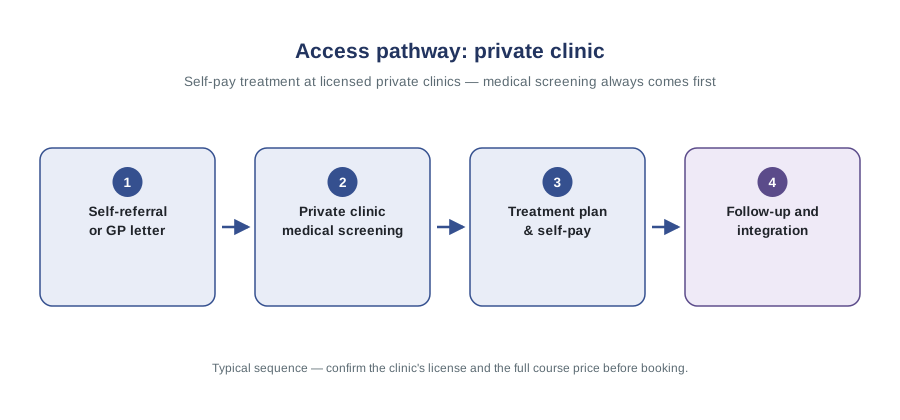
How to start and what to check. You can self-refer; expect a psychiatric and medical screening across the first appointments before any treatment decision. Before starting, ask for a written per-session and per-course cost breakdown and establish exactly what your sickness fund will refund. Submit the Wahlarzt invoices: the partial refund is a legal entitlement, not a favour. Off-label ketamine formats beyond the authorized nasal spray should come with a clear medical rationale, supervision and monitoring; a practice that offers the medicine without structured screening and follow-up is a warning sign.
Psilocybin and MDMA: research only
Psilocybin, psilocin, MDMA and the other classic psychedelics are controlled under Austria's narcotic-substances law, the Suchtmittelgesetz, with the substances listed in the annexes of the implementing regulation (Anlage V). There is no medical-access, compassionate-use or reimbursement route for either substance (the national compassionate-use list contains no psychedelic program), and anyone offering psilocybin or MDMA therapy commercially in Austria is operating illegally.
What Austria does have is research. The Medical University of Vienna is recruiting for a psilocybin study in people with depression and anhedonia (NCT07490353): an early-phase, imaging-heavy study of how psilocybin affects the capacity to feel pleasure, run at the university's Department of Psychiatry and Psychotherapy. Be clear about what that is: a mechanistic study with two supervised sessions and extensive MRI work, not a treatment program. Participation, though, is free, legal and carefully screened. No Austrian MDMA trial is recruiting as of July 2026. If MDMA-assisted therapy matters to you, the realistic options are watching the registries or considering trial sites elsewhere in Europe; our trials guide explains how.
Clinical trials in Austria
The research route is stronger than the country's size suggests: Blossom tracks 14 trials connected to Austria, five of them active (country report). Recruiting studies include:
- The Vienna psilocybin and anhedonia study above (NCT07490353) at the Medical University of Vienna.
- INTENSIFY MDD (NCT05973851), a European Phase 3 study of early-intensified treatment (a second-line antidepressant plus esketamine or ketamine) versus treatment as usual after a first failed antidepressant, with an Austrian site at the Medical University of Innsbruck.
- Ketamine studies at the Medical University of Vienna's fast-acting antidepressant group, including work in obsessive-compulsive disorder.
Participation is free and legal, but screening is strict and enrolment is never guaranteed. See the trials guide for how phases, placebo and consent work, browse trial sites in Austria, and search ClinicalTrials.gov for current listings.
What to expect in treatment
Medically reviewed by Dr. Amy Reichelt, PhD, 31 July 2026: this section and the risks section below.
These routes share a shape (medical screening, supervised administration, structured follow-up), but they are not interchangeable: the indication, the schedule, the staffing and the strength of the evidence all differ depending on whether you are prescribed Spravato (esketamine), given ketamine, or entering a legal psychedelic-assisted therapy route, where your country has one. What every route has in common is where it starts. Treatment begins with a screening appointment: the clinician reviews your psychiatric and medication history, checks your cardiovascular health and current medicines, and confirms the diagnosis before anything is scheduled. This is also where contraindications are caught.
On a Spravato day you self-administer the nasal spray in the practice or clinic under supervision, then stay for an observation period of roughly two hours while staff monitor blood pressure, heart rate, sedation, dissociation, breathing and overall recovery. Dissociation, dizziness, sedation, nausea and a temporary rise in blood pressure are common (though they do not occur in everyone), and settle as the drug clears. You must not drive, operate machinery or undertake anything hazardous until the following day, after a night's sleep, so arrange transport home. Induction is typically more frequent at first and then tapers based on measured response. Under the European label, Spravato for treatment-resistant depression is taken alongside a continuing oral SSRI or SNRI antidepressant.
A ketamine infusion for depression is an off-label use of the drug. It is usually given intravenously over about 40 minutes, with vital-sign and psychological monitoring and a recovery period afterwards. Some services offer ketamine-assisted psychotherapy (KAP), which wraps the dosing in preparation and integration sessions with a therapist; others provide ketamine as a medical antidepressant treatment with no psychotherapy component at all, which is worth establishing before you book. Where a legal psychedelic-assisted therapy route exists, and what that route is depends on the country: a clinical trial in most, a regulated programme or compassionate-use scheme in a few; dosing days are long and closely supervised by trained clinical staff, and sit inside a broader plan of preparation, general psychiatric care and integration. In every setting the medicine is one part of the plan: screening, monitoring and follow-up reduce risk but cannot eliminate it, and psychotherapy or integration may help you make sense of what the treatment brings up and apply it afterwards.
Risks and who should not start
These treatments are generally well tolerated under supervision, but they are not for everyone, which is exactly what screening is for. Common, transient effects during or shortly after a session include dissociation (a detached, dreamlike feeling), nausea, mild perceptual changes, and a short-lived rise in blood pressure and heart rate; these resolve as the drug is metabolised. Treatment may be inappropriate, or require particular caution and specialist evaluation, when any of the following apply:
- Uncontrolled hypertension or significant cardiovascular instability, including a history of aneurysmal vascular disease. This is a contraindication for Spravato, because of the temporary rise in blood pressure; the other treatments carry their own cardiovascular assessment.
- A personal or family history of psychosis or bipolar disorder: a particular caution for classic psychedelics such as psilocybin, which legal programmes screen for carefully.
- Pregnancy or breastfeeding.
- Current uncontrolled substance use, a history of ketamine misuse, or a high risk of compulsive use: any of these may make treatment inappropriate or require specialist assessment.
A responsible provider screens for all of these before the first dose. Careful screening, monitoring and follow-up reduce risk; they do not remove it. If a clinic is willing to treat you without that assessment, treat it as a warning sign; see our clinic-choice guide. To see who is listed near you, browse providers in Austria.
Reviewer's note. Ketamine, Spravato (esketamine) and psilocybin-assisted therapies share common elements such as screening, supervision and follow-up, but they should not be presented as interchangeable. Each has distinct indications, contraindications, monitoring requirements and levels of evidence. Spravato follows a regulated treatment pathway, while IV ketamine is generally used off-label and psilocybin therapies remain largely investigational. Importantly, careful screening and clinical monitoring reduce risk but do not eliminate it.
— Dr. Amy Reichelt, PhD, neuroscientist, chartered psychologist and psychotherapist, PsyAccess medical reviewers
Frequently asked questions
Does Austrian public insurance pay for Spravato?
Sometimes, and the setting decides. As an inpatient, esketamine is funded within the hospital stay through LKF financing. As an outpatient, your sickness fund covers it only with a case-by-case chefärztliche Bewilligung; without one, you pay privately. There is no routine outpatient entitlement.
What is a chefärztliche Bewilligung and how do I get one?
It is the sickness fund's chief-physician approval for a treatment outside routine coverage. Your psychiatrist files it, and it stands or falls on your documented treatment history: every antidepressant tried in the current episode, with dose, duration and outcome. Ask your psychiatrist to submit it before you commit to self-pay.
How much does private esketamine treatment cost in Vienna?
EUR 150–450 per session, per the practices' published fee schedules: at Dr. Buchmayer's practice, a first consultation is EUR 400 and an esketamine session EUR 150–250; at PsyTherapie, a session is EUR 350, or EUR 450 combined with psychotherapy. A full induction course means several sessions over about a month, so ask for a per-course total in writing.
Will my sickness fund refund part of a private (Wahlarzt) bill?
Yes: that is how the Wahlarzt system works. PsyTherapie, for example, indicates a typical refund of EUR 80–110 per session. Submit every invoice to your fund, and ask the practice which items are refundable before treatment starts.
Is psilocybin therapy legal in Austria?
No. Psilocybin is controlled under the Suchtmittelgesetz, and the only legal contact with it is inside an authorized study, currently the Medical University of Vienna's trial in depression with anhedonia. Anyone selling psilocybin therapy in Austria is acting illegally.
Can I get MDMA-assisted therapy in Austria?
Not outside research, and no Austrian MDMA trial is recruiting as of July 2026. The realistic options are watching the registries for new studies or considering trial sites elsewhere in Europe.
Coming from another country? Whether a clinic will take a non-resident self-pay patient, what a Spravato induction schedule means for a visitor, and where cross-border treatment actually works: ketamine & psychedelic therapy in Europe for international patients.
Sources
- Blossom: Austria country report
- Blossom: Medical access in Austria
- Psychedelic Alpha: Worldwide psychedelic laws tracker
- Psychedelic Alpha: Beyond Clinical Trials — psychedelic-assisted therapy in Europe's real world (01/2026)
- EMA: Spravato (esketamine) EPAR
- Suchtgiftverordnung, Anlage V — controlled psychotropic substances (Austria)
- Medical University of Vienna — fast-acting antidepressants research group
- ClinicalTrials.gov: NCT07490353 — psilocybin and anhedonia in depression (Medical University of Vienna; recruiting)
- ClinicalTrials.gov: NCT05973851 — INTENSIFY MDD (Austrian site: Medical University of Innsbruck)
- Ordination Dr. Buchmayer, Vienna — services and fee overview
- PsyTherapie — Dr. Platz, Vienna and Klagenfurt: services and fee schedule
- Gesundheit Österreich / PPRI — pharmaceutical pricing and reimbursement in Austria (2024)
This guide is for general information only and is not medical advice, a diagnosis, or a recommendation of any treatment. Funding decisions in Austria are made case by case, and practice fees change; always verify current costs and coverage with the practice, your sickness fund, or a licensed clinician who knows your history. If you are in crisis, contact your local emergency number or a crisis line immediately.
This guide awaits review by a licensed medical professional.